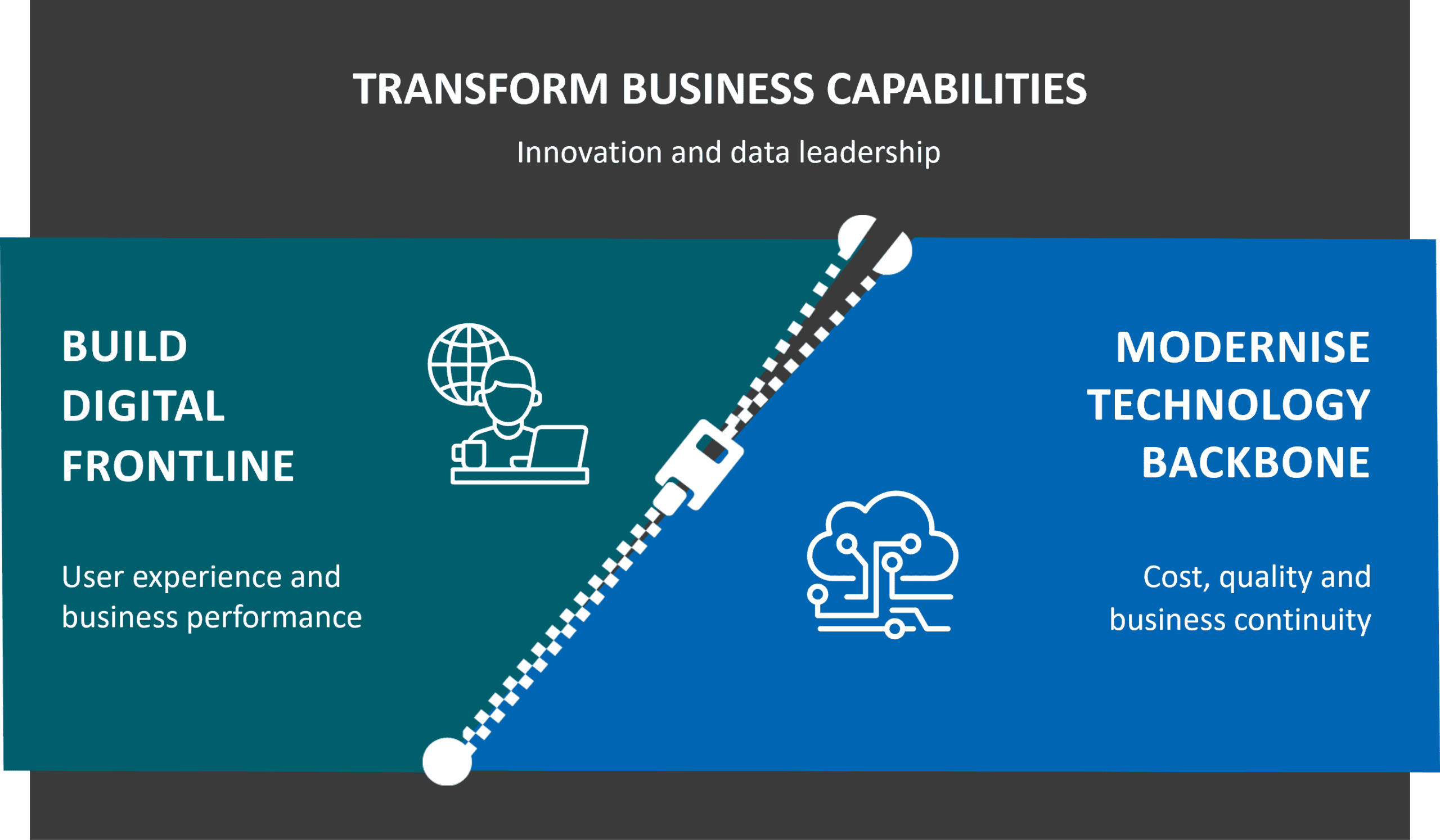
The business technology operating model defines how an organisation creates measurable business value through the integration of business and technology development. In many organisations, value creation has been approached through delivery efficiency, where business needs are handled as requests and success is measured by how effectively they are implemented. While this measures IT organisation’s capability, it does not always ensure that development work leads to meaningful business outcomes.
The operating model acts as the management system for business technology, defining how work, decisions, roles, capabilities, governance, tools, and feedback loops operate together.
In the business technology operating model, value creation is based on continuous collaboration between business and technology. Business capabilities are designed jointly, combining business understanding with technology possibilities, and translated into development roadmaps that guide both long-term evolution and individual initiatives. While development may be executed through projects, agile flows, or other models, alignment is not limited to the start of an initiative but continues throughout its lifecycle.
Business and technology functions work together to shape, refine, and prioritise development needs, ensuring that both business relevance and technical feasibility are considered continuously. This avoids situations where needs are defined once and then executed without ongoing alignment.
The operating model shifts the focus from managing activities to managing value. It is based on continuous joint effort between business and technology across the full flow, from capability design to service use. This ensures that development remains aligned with real needs, enabling faster time-to-value and more predictable delivery of business outcomes.
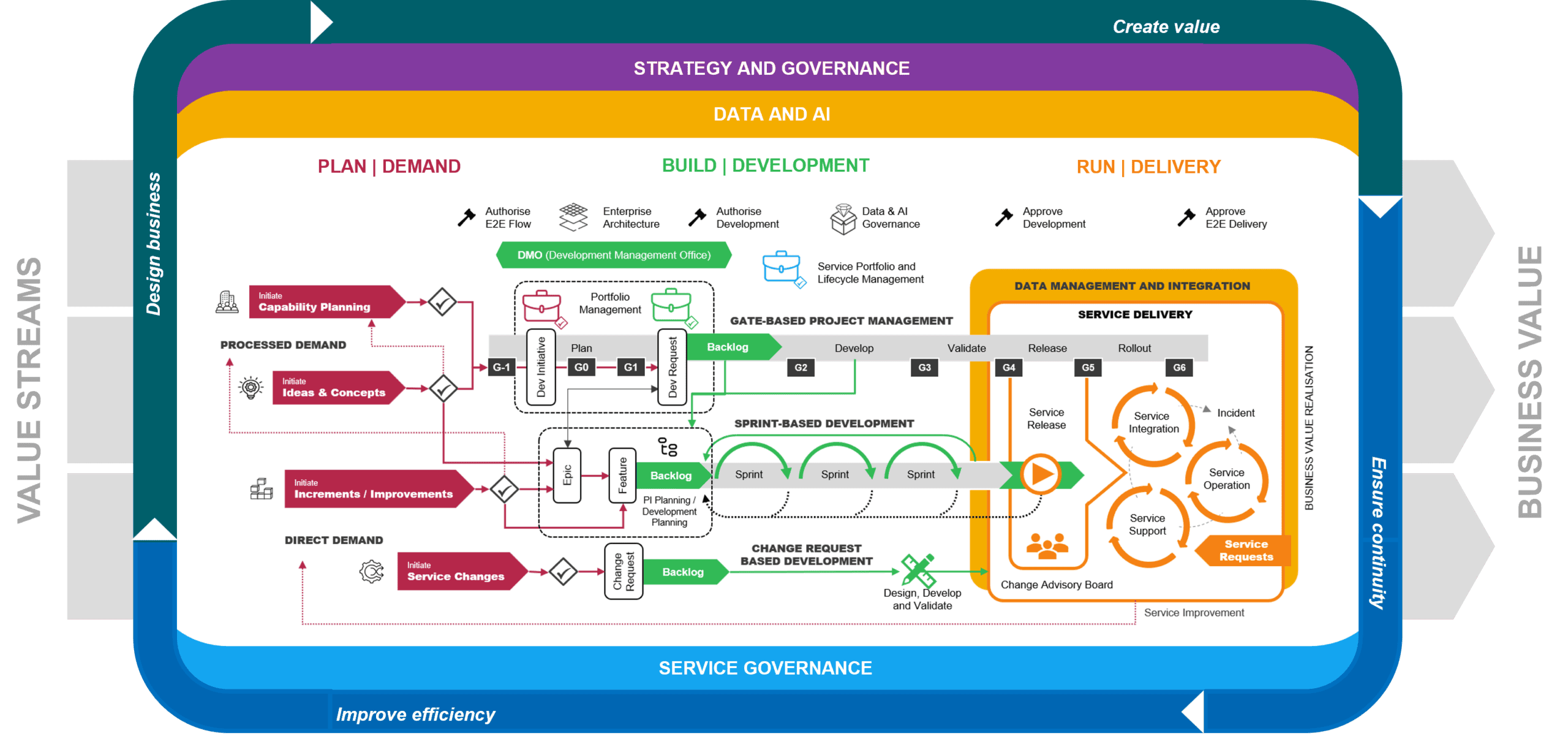
The business technology operating model is built around an end-to-end value creation flow. Plan, build, and run are not separate phases but connected parts of the same lifecycle. Each step builds on the previous one and contributes to business outcomes.
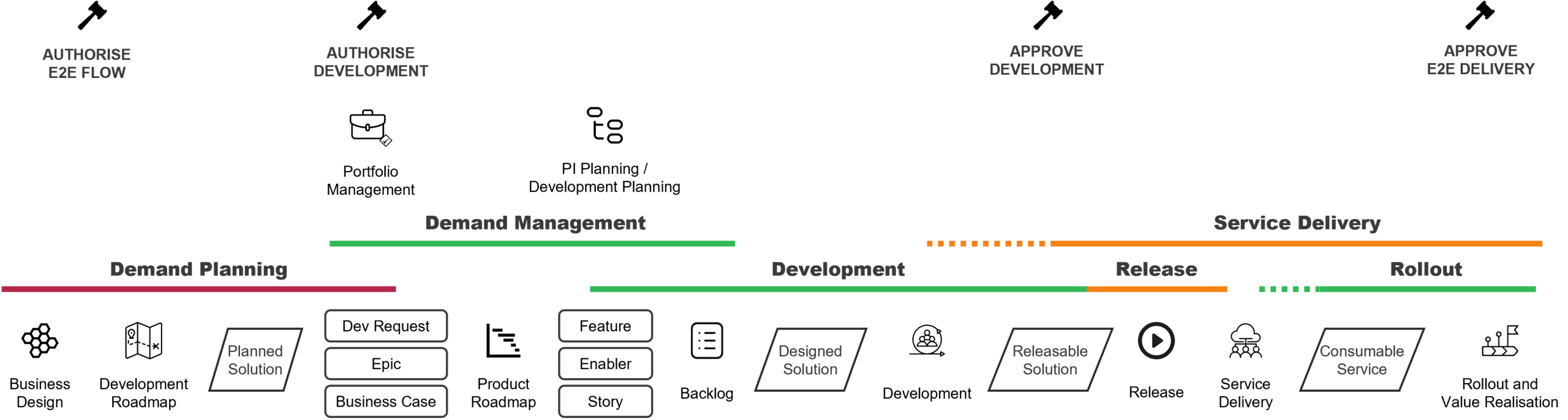
Value creation begins before formal development request. Business needs are identified and shaped through business design and early planning. This ensures that development starts with a clear understanding of the problem, the expected outcomes, and the business impact. Early alignment between business and technology is essential to avoid rework and ensure that development effort is directed towards meaningful outcomes.
Demand planning and management translate these needs into structured initiatives. Development turns these initiatives into working solutions. Service delivery ensures that the solutions deliver value in daily operations and continue to improve over time. The flow is continuous, with insights from operations feeding back into new demand and future development.
The end-to-end value creation flow is supported by a set of capabilities that together form the Business Technology Capability Model. These capabilities are organised into six disciplines: demand, strategy and governance, service governance, development, service delivery, and data and AI. Together, they define what the organisation must be able to do consistently to create business value.
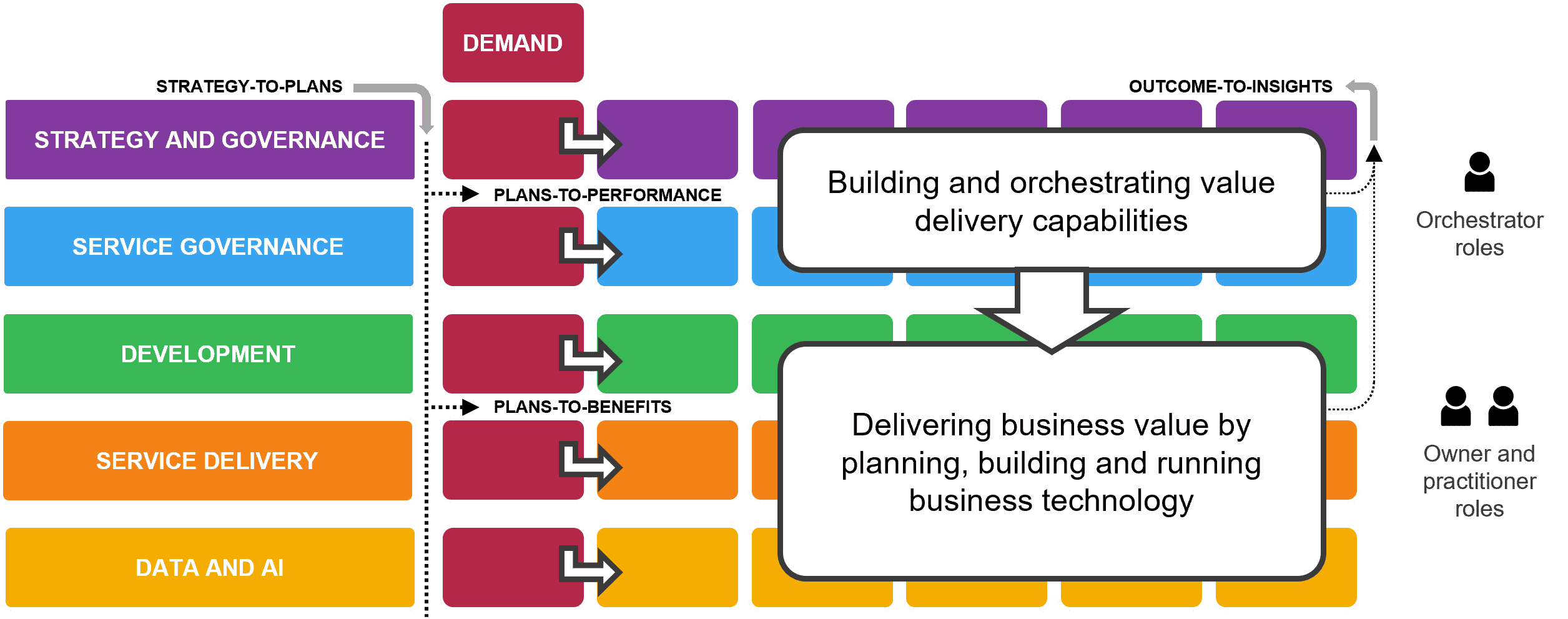
The demand discipline ensures that business needs are understood, shaped, and prioritised before development begins. Its purpose is to connect strategy with execution by continuously translating business priorities into actionable development opportunities.
Strategy and governance provide direction, alignment, and decision-making structures across the organisation. They ensure that business technology efforts remain focused on the most important objectives while maintaining control, transparency, and accountability.
Service governance ensures that services, resources, and ecosystems are managed as a coherent whole. Its purpose is to balance cost, performance, and sustainability while enabling the organisation to leverage partners and platforms effectively.
The development discipline converts prioritised needs into usable solutions. Its role is to ensure that development is efficient, coordinated, and capable of delivering solutions that meet both business and technical expectations.
Service delivery ensures that solutions are successfully used in business operations. It focuses on reliability, usability, and continuous improvement, ensuring that services deliver value consistently over time.
The data and AI discipline ensures that data is treated as a strategic asset. It enables better decision-making, automation, and new value creation by making data available, reliable, and usable across the organisation.
Together, these disciplines create a coherent operating model where business and technology work as one, enabling continuous value creation from strategy to realised business outcomes.
A central principle of the operating model is end-to-end accountability for value. Each development flow is managed from initial idea to realised outcome. This includes defining expected benefits, delivering the solution, and ensuring that the value is achieved in practice.
This changes how success is measured. Instead of focusing on delivery milestones or technical outputs, the focus is on business impact. For example, improved customer experience, reduced lead times, or increased efficiency.
Not all business needs are the same. The operating model recognises different types of demand, such as long-term capability development, innovation and concepts, incremental improvements, service changes, and user-initiated service requests. Each type is managed differently, ensuring that larger initiatives receive proper planning and governance, while smaller changes can be delivered quickly.
To manage complexity, work is organised into value streams, each acting as a focused portfolio aligned to a specific business goal, with dedicated stakeholders responsible for prioritisation, resources, and outcomes. These value streams operate as active portfolios, where work is prioritised, resources are allocated, and development is guided based on business goals. This keeps decision-making close to the business and improves responsiveness.
Governance supports this structure through the principle of minimum viable governance, where decisions are made at the lowest effective level and escalated only when needed. This reduces delays and ensures that governance enables progress rather than slowing it down.
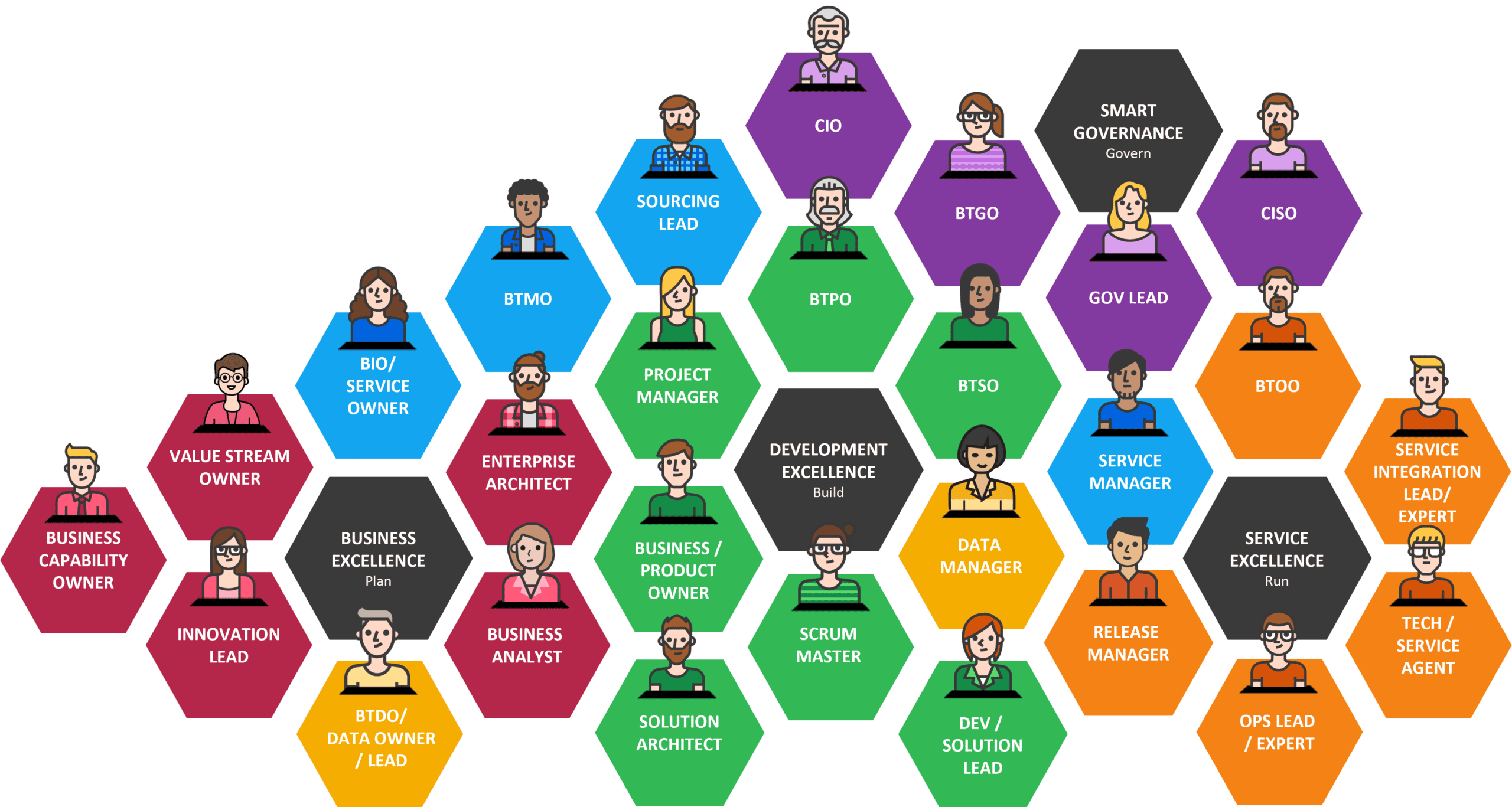
Clear roles and responsibilities reinforce this way of working. When ownership is well defined, less control is required, allowing teams to focus on delivering outcomes.
The Business Technology Governance Officer (BTGO) ensures that the operating model, governance practices, and management tools remain aligned with the way the organisation creates value. The Business Technology Portfolio Officer (BTPO) ensures that portfolio and development flow information is visible, comparable, and usable for steering.
Value creation does not end when a solution is delivered. It is realised in daily operations, where services are used and business outcomes take shape.
Services play a central role in this. They provide visibility into performance, capture feedback from users, and highlight where expected outcomes are not yet achieved. When gaps are identified, they are addressed through new demand and development, ensuring that improvements are based on real business needs.
This creates a continuous cycle. Insights from operations shape future planning, and development builds on what has been learned in practice. Over time, this strengthens the organisation’s ability to deliver value in a consistent and controlled way.
In practice, the operating model provides a clear and shared way of working. Business and technology take joint ownership of outcomes, work together from the start, and stay focused on measurable results. By structuring work through capabilities, value streams, and end-to-end flows, the organisation improves responsiveness, reduces unnecessary complexity, and ensures that technology investments support business success.
Business technology requires integrated tools that support end-to-end value creation and governance. Rather than using separate tools for planning, development, and service operations, the operating model is best supported by a connected toolset that provides a continuous view from business needs to realised value.
An effective operating model system integrates the plan, build, and run phases into a single end-to-end flow. It enables traceability from strategy and objectives to development initiatives, backlog items, releases, and services in operation. At the same time, it supports governance by embedding decision points, workflows, and approvals according to the operating model disciplines. This allows governance to be implemented as part of everyday work rather than as a separate layer.
Traditionally, operating model tools have focused on governance and enterprise-level visibility, providing dashboards, reporting, and control mechanisms. While this remains important, the role of tools is evolving. Increasingly, value creation work itself is supported by intelligent automation and AI agents. These can assist in producing business plans, refining backlog items, generating design and validation artefacts, and supporting service delivery tasks.
As a result, operating model tools are shifting from systems of control to systems of value creation. They combine visibility, governance, and execution support into a unified environment, enabling both decision-makers and teams to work more effectively across the full end-to-end flow.