Business technology operations require financial and human resources as well as information technology and data assets. While financial resources are addressed in financial planning and control, this capability focuses on managing the resources and assets that enable development and operations.
Resource and asset management ensures that the organisation has the resources required to perform business technology work and that relevant assets are controlled throughout their lifecycle. Resources provide operational capacity through people, partner capabilities, services, automation and other available means. Assets include controlled information technology and data assets that have defined ownership, value, rights, obligations and lifecycle status.
Increasingly, organisations also utilise AI-enabled capabilities and software-based resources that support operational execution, automation, analytics, and decision-making. This expands available operational capacity and enables organisations to respond more flexibly to changing demand.
Resource management follows a structured lifecycle consisting of four key activities: forecasting demand, building capacity, fulfilling demand and optimising usage.
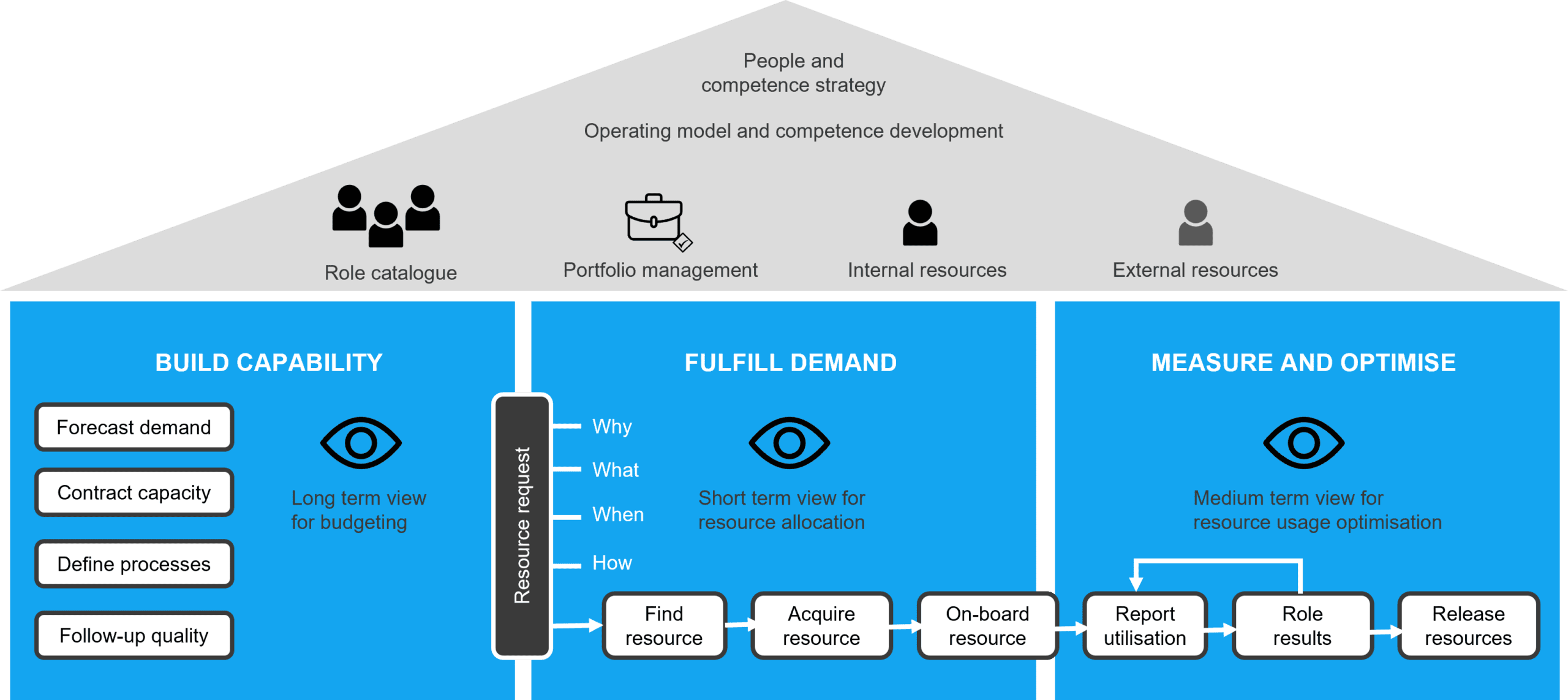
Forecasting demand begins with understanding current utilisation and estimating future needs. This includes analysing changes in demand across services, development initiatives and value streams to identify the required resource.
Building capacity ensures that the organisation is ready to meet expected demand. This includes preparing commercial agreements, ensuring availability of internal and external resources, and maintaining readiness to onboard resources efficiently and in compliance with policies and standards.
Fulfilling demand focuses on providing the required resources through a controlled process. Requests are authorised, and work is assigned to the most suitable resources, whether through internal capacity, external providers, or predefined resources available within the organisation. Increasingly, this process is supported by automated workflows and structured catalogues, enabling faster fulfilment while maintaining governance and traceability.
Optimisation ensures that resources are used efficiently and remain aligned with business needs. This includes identifying underutilised resources, consolidating suppliers and agreements, and adjusting capacity based on demand and strategy. Optimisation also includes improving how work is executed by enabling reuse and scaling of resources to support changing demand.
Optimisation increasingly includes automation, reusable digital capabilities, and AI-supported execution. Organisations may utilise software-based capabilities and AI agents to support operational activities, improve scalability, reduce repetitive manual work, and respond more flexibly to changing demand. Resource management therefore needs to govern both human and software-based resources as part of the same operational capability structure.
Resources provide the capacity needed to perform business technology work. They can include people, partner capacity, teams, services, automation and digital workers. Assets are controlled items that have defined ownership, value, rights, obligations and lifecycle status. They are managed through authoritative records and appropriate lifecycle controls.
Asset management ensures that material information technology and data assets are controlled throughout their lifecycle. Organisations maintain authoritative records of relevant assets, with clear ownership, usage rights and entitlements, together with applicable licence, contract, security and data protection obligations. Lifecycle status and obsolescence are monitored so that risks, costs and replacement needs can be addressed in time. Material asset information is linked to service data where needed to support service, sourcing and financial decisions.
In practice, resource management increasingly focuses on people and ecosystem partners. Organisations rely more on external providers and service-based sourcing, shifting from owning all required capability directly to consuming resources as services. This trend requires close alignment with sourcing and supplier management to ensure availability, flexibility, and cost control.
At the same time, standardisation plays an important role. Frequently used resources, automation capabilities, AI agents, and digital worker models are predefined and made available through structured catalogues. This enables faster onboarding, reduces repeated negotiation, improves consistency, and supports automation in fulfilment processes.
Digitalisation and agile ways of working are shifting resource management from individual roles to teams and service-based delivery. These teams combine the necessary skills and follow established ways of working, enabling faster delivery and reducing coordination effort.
Increasingly, AI agents and digital workers are also part of the operational team structure, supporting execution, automation, coordination, analytics, and operational scalability alongside human team members. This expands the available capability portfolio beyond traditional organisational structures. Teams can combine human expertise, ecosystem capabilities, automation, and AI-supported execution to respond more flexibly to changing business needs and operational demand.
At the same time, standardisation plays an important role. Frequently used resources, automation capabilities, AI agents and digital worker models are predefined and made available through structured catalogues. This enables faster onboarding, reduces repeated negotiation, improves consistency and supports automation in fulfilment processes.