Data and AI are used across many services, processes and development initiatives. Without a clear structure, data becomes fragmented, responsibilities are unclear, and improvement efforts compete with each other.
Data domains and data assets provide a practical way to organise data so that it can be developed, governed and reused over time. They make it clear who is accountable, where decisions are made, and how data development is linked to broader change.
A data domain is a coherent set of data with shared meaning, used across multiple services, processes or systems. Domains provide a stable unit for ownership and governance that can be maintained even as solutions and technologies change.
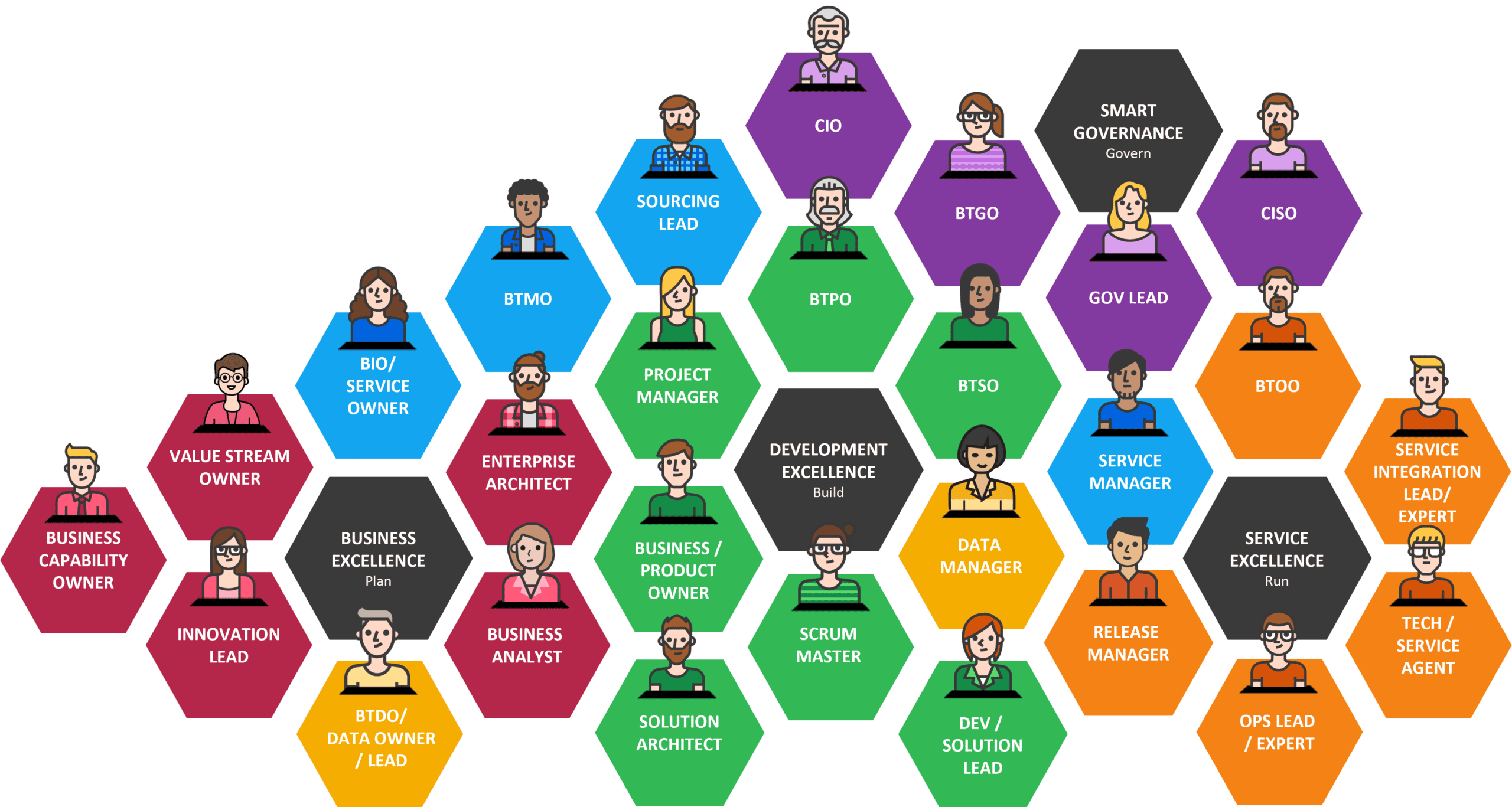
Each domain has a named Data Domain Owner who is authorised to make decisions, prioritise improvements and guide development within the agreed scope. This ownership enables progress and accountability. Without it, domains tend to become fragmented collections of data rather than actively managed business assets.
Domains can be managed centrally, locally or through a combination of both. The appropriate model depends on how the data is used and where consistency is required. For example, product data may include a centrally governed and unified core that ensures shared identifiers and structures, while more detailed or specialised product information is defined and managed locally by individual business units.
This hybrid approach allows the organisation to balance standardisation and flexibility. Common data is governed centrally where reuse and comparability matter, while local data evolves where business needs differ.
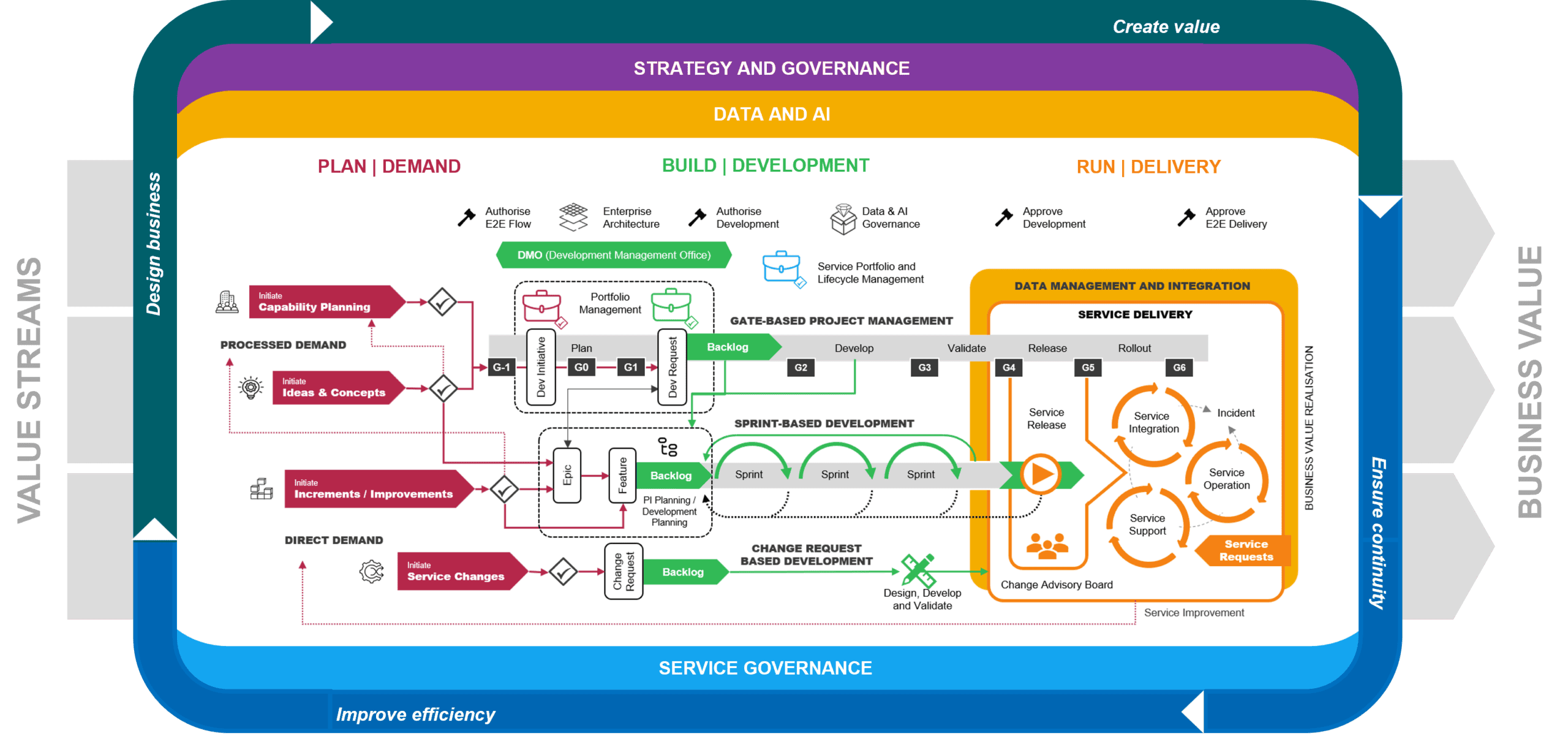
In the Business Technology Standard, value streams are used to plan and prioritise development. They bring together related development needs and provide a shared focus for deciding what to improve next. Value streams are not a description of organisational structure or daily operations, but a way to manage transformative development.
Data domains need to be connected to this development structure. Otherwise, data development easily becomes detached from the initiatives and capabilities that depend on it.
Ideally, a data domain aligns closely with a value stream. In practice, data domains are often shaped by organisational responsibilities, regulatory requirements or the need for stable ownership. Value streams, by contrast, are cross-organisational and change as priorities evolve.
For this reason, each data domain must have a clearly defined primary value stream home. This defines where development needs are mainly identified, where prioritisation decisions are made and which perspective drives investment and change. A domain may support several value streams, but one value stream provides its main direction.
Each data domain is composed of data assets. A data asset is a clearly defined and manageable set of data that supports a specific business purpose. Because assets are smaller in scope than domains, their ownership and management responsibilities are easier to assign and maintain.
For example, within a customer data domain, one data asset may be customer contact details. This asset defines how customers or client organisations can be identified and contacted and which contact information is considered valid and usable.
The asset may include data objects such as organisation entity and contact location. The organisation entity object captures who the organisation or customer is and may include data elements such as entity name, organisation type and unique identifiers. The contact location object captures where and how the organisation can be reached and may include data elements such as street address, postal code, city, country, email address, telephone number, and consent or preference indicators.
Defining the asset, objects and elements explicitly makes responsibilities clear and supports consistent use of contact information in services, communications, automated processes and AI-enabled capabilities.
This becomes more important as AI agents and AI-enabled capabilities use data to support decisions, interact with users and trigger actions. Data assets must be clear enough for operational use, including explicit definitions, quality expectations, allowed use, lineage, access rules and lifecycle ownership.
This layered structure, from domain to asset to object to element, allows responsibility to be distributed in a practical way. Domain ownership provides overall accountability, while asset-level ownership enables focused management of quality, usage and lifecycle decisions.
The Business Technology Data Officer ensures that domain and asset structures, ownership practices and investment priorities are embedded into the business technology operating model. This keeps data development connected to governance, portfolio decisions and business capability development.
Data assets can also be understood through the analogy of a diamond. In their raw form, data assets often exist without clear ownership, agreed definitions or consistent quality expectations. Even when data is held within a single system, its value may remain limited if responsibilities are unclear, quality varies or usage rules are not defined. Like rough stones, their potential value is high, but unrealised.
Value is created when a data asset is deliberately developed and managed from several complementary perspectives.
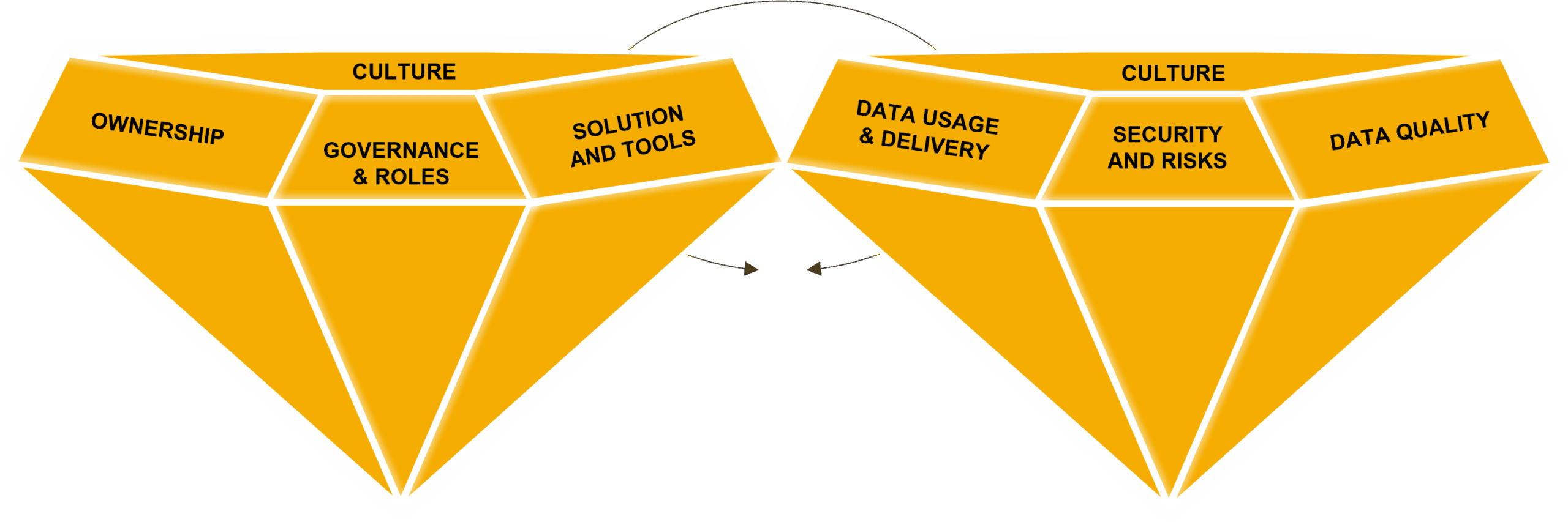
Ownership establishes clear accountability for outcomes and prioritisation. Governance and roles define how decisions are made, how standards are applied and how changes are approved. Usage and delivery determine how the asset is made available and used in services, processes and development initiatives. Security and risk management ensure that access is appropriate and that legal, regulatory and operational risks are controlled. Data quality ensures that the asset can be trusted for its intended use.
Culture underpins all of these perspectives. It influences how consistently agreed practices are followed in everyday work, how issues are raised and resolved, and how seriously ownership and accountability are taken.
Just as a diamond only becomes valuable when all its facets are cut and aligned, a data asset only becomes valuable when these perspectives are managed together. Focusing on a single aspect, such as cleansing data without clear ownership, or investing in tools without agreed definitions, limits overall value.
Managing data at the asset level also supports reuse across processes and systems. Assets can be shared without duplicating definitions or controls, reducing fragmentation and inconsistency.
Not all data assets have the same importance or require the same level of investment. Data assets should therefore be classified based on the role they play in the organisation.
A practical classification distinguishes between:
This classification helps assess the relative importance of data assets and supports informed investment decisions. Assets with higher business value justify sustained investment in quality, governance and development. Necessary data must be reliable and compliant but needs no further improvement beyond that.
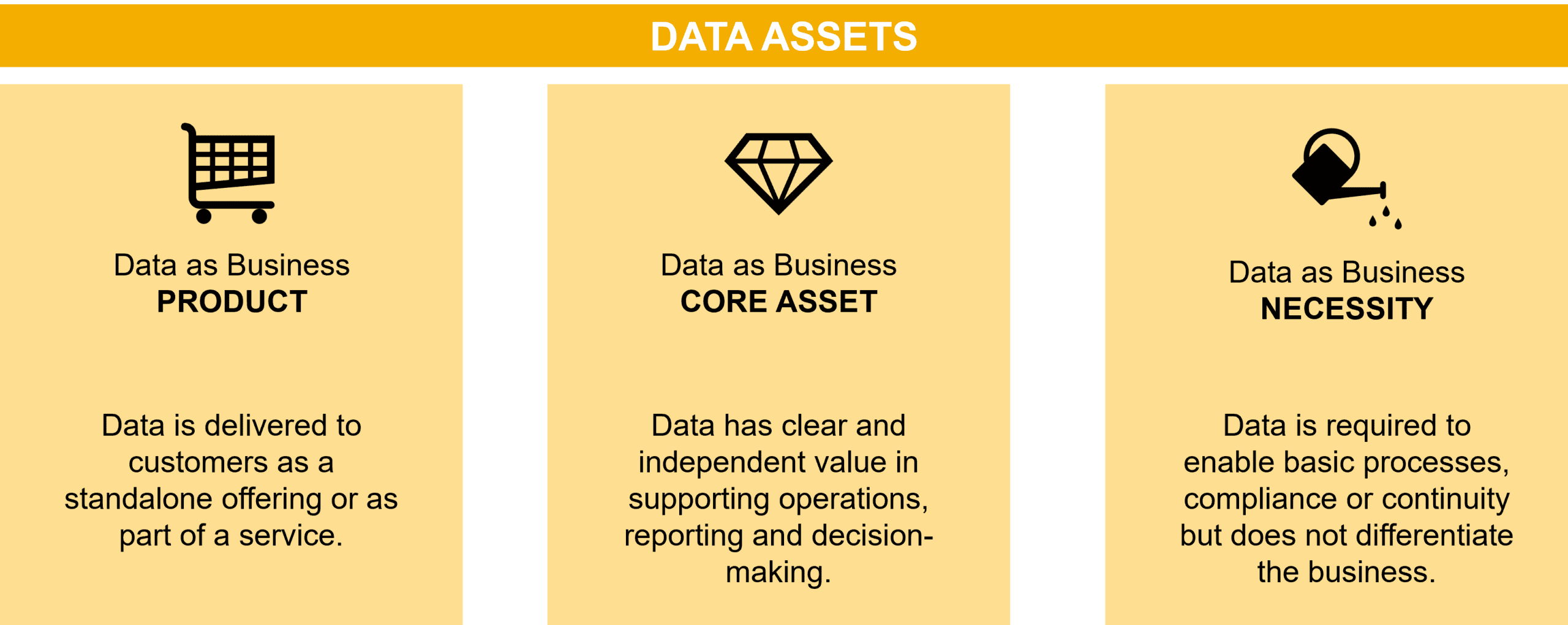
By making these distinctions explicit, the organisation can better evaluate the return on data investments, prioritise development efforts and align funding with business outcomes.
Data domains and data assets provide a practical way to manage complexity. They allow the organisation to assign ownership, balance central and local control, and focus investment where data creates the most value.
When domains are clearly defined and assets are actively managed, data and AI become reliable foundations for decision-making, automation and long-term business development rather than fragmented collections of information tied to individual systems or projects.