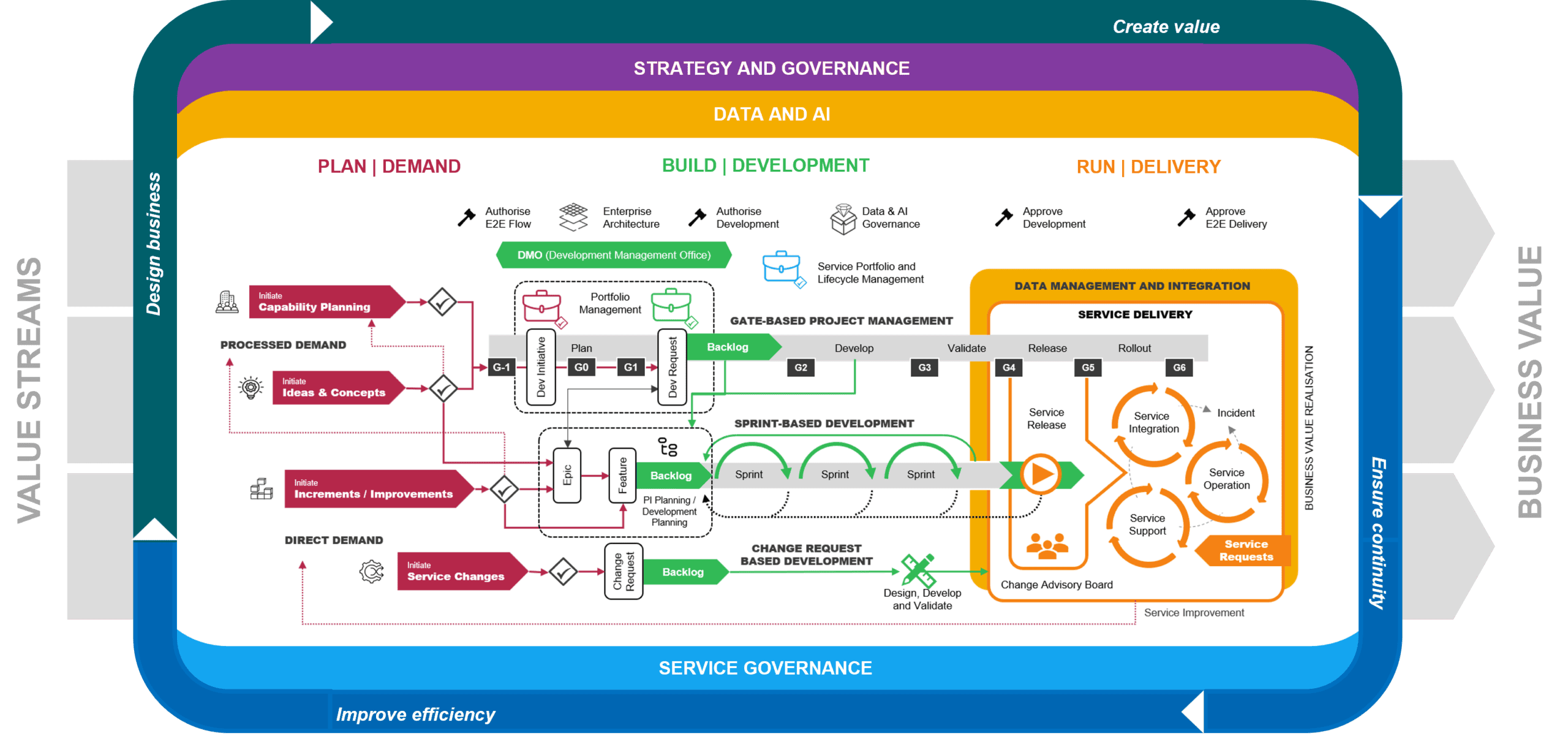
Service delivery ensures that services operate reliably, securely, and effectively in daily use. It connects operational service commitments, operational execution, user support, operational learning, and lifecycle improvement into single, coherent operational flow.
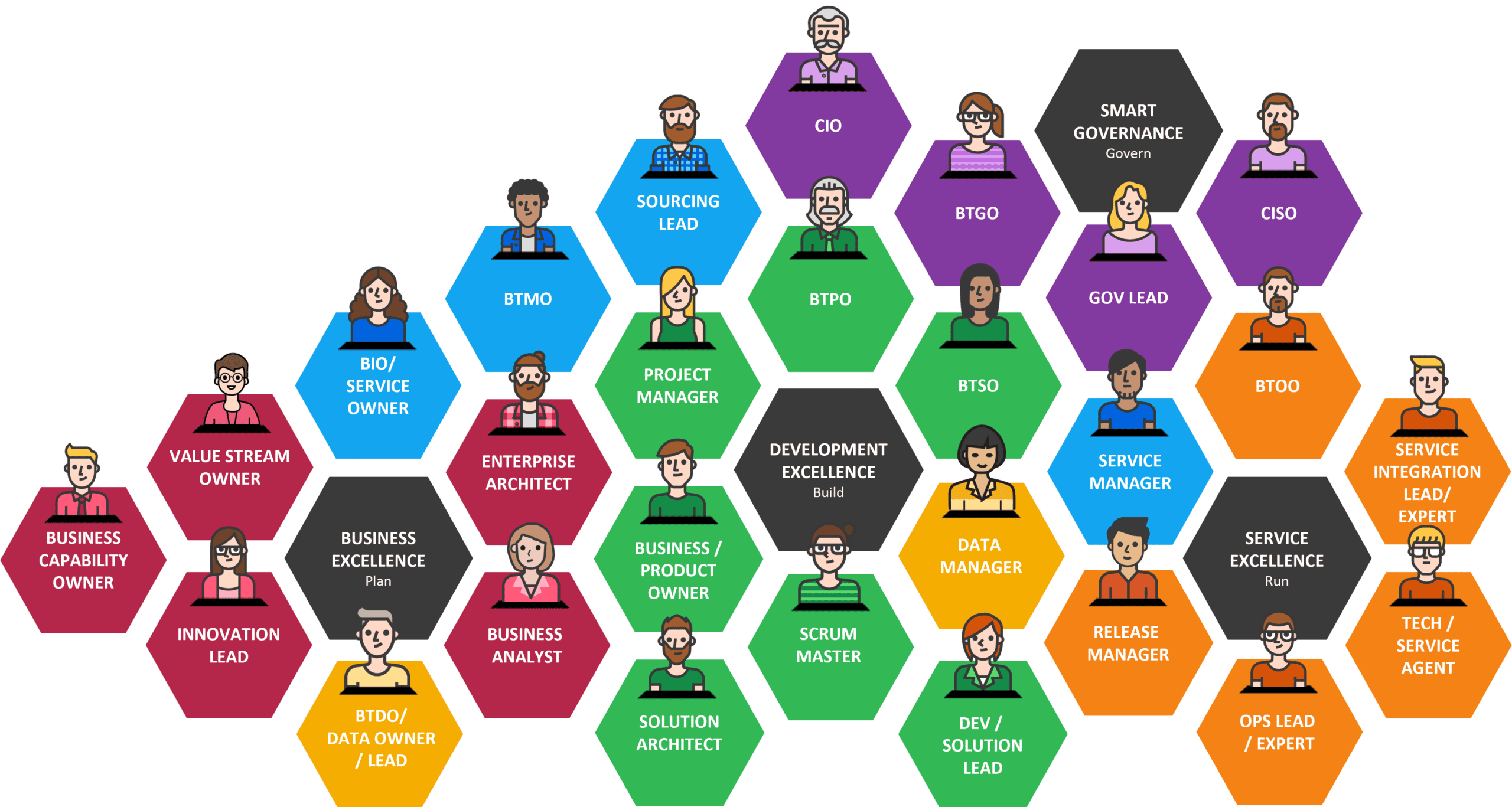
Service delivery is an operational capability as much as a support capability. It brings together business ownership, service management, operational teams, providers, platforms, automation, AI agents, and governance to ensure that services remain usable, recoverable, supportable, and continuously improving throughout their lifecycle.
The objective extends beyond keeping services running. Service delivery ensures that services create value in real operational environments by combining reliable operations, effective support, operational resilience, and continuous adaptation to changing business and operational needs.
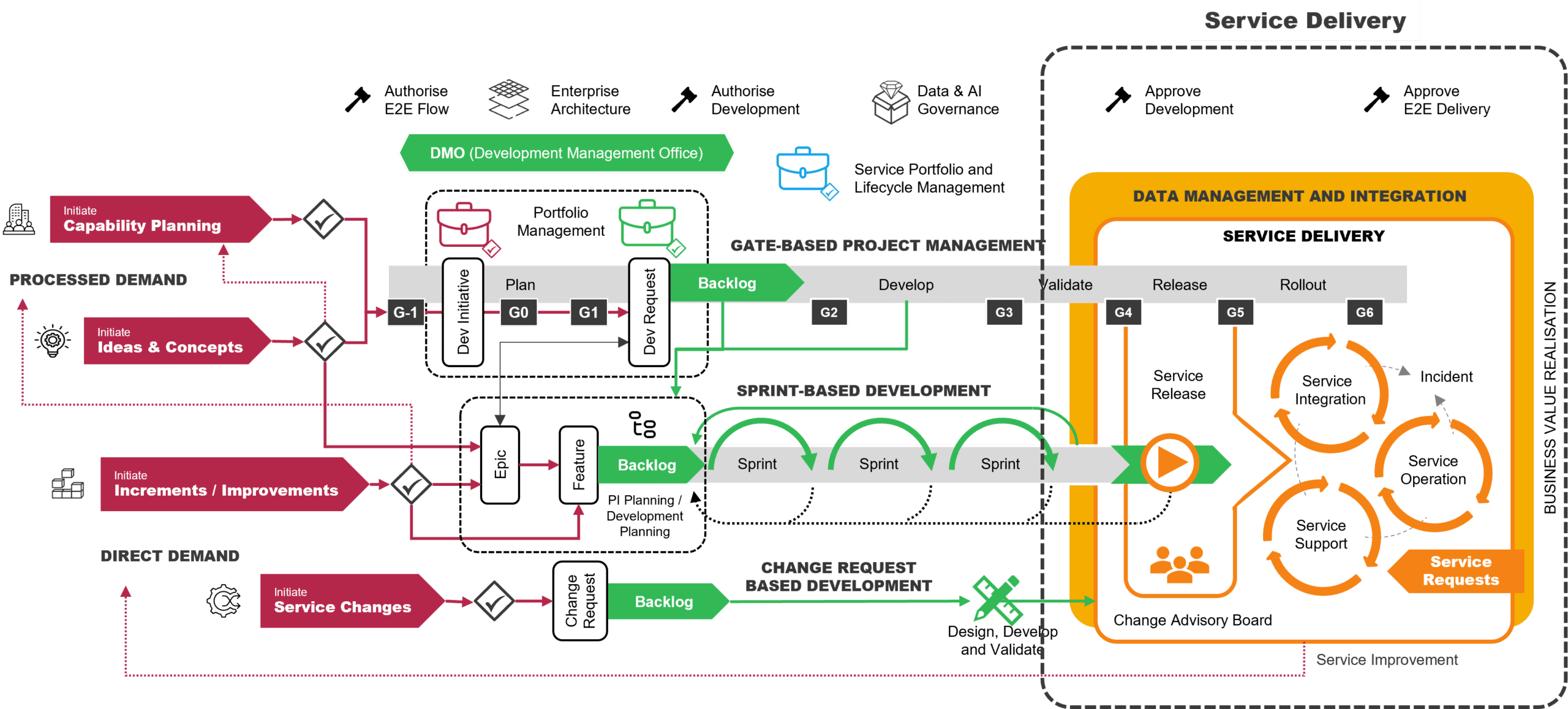
Service delivery begins from defined service commitments. Services are introduced with agreed service scope, service levels, continuity expectations, operational ownership, support models, and provider arrangements. These commitments define what services the organisation provides, how they are operated, and what level of operational continuity and support is required.
Service delivery turns these commitments into operational reality. This requires more than technical operations. It requires coordinated service integration, operational readiness, continuous operations, operational resilience, user support, operational learning, and lifecycle management across increasingly distributed service ecosystems.
Modern services operate across internal teams, external providers, cloud platforms, operational technologies, automation layers, and AI-enabled operational capabilities. Operational failures increasingly emerge across dependencies, integrations, provider ecosystems, automated operational chains, and data flows rather than within isolated systems.
Service delivery therefore focuses strongly on:
Operational service environments also generate continuous operational insight. User behaviour, support interactions, operational analytics, service usage patterns, automation data, and AI-assisted analysis provide valuable input for operational improvement, future development, and service evolution.
Artificial intelligence significantly changes service operations, support, operational coordination, and lifecycle management.
AI agents are part of the operational workforce and participate in operational processes, user support, monitoring, analytics, operational coordination, and automated decision-making. This increases operational scalability and responsiveness while also increasing dependency complexity, monitoring requirements, governance expectations, and the importance of operational transparency.
Service delivery therefore evolves towards hybrid operational environments where human teams, providers, automation platforms, and AI agents operate together as one coordinated operational capability.
At the same time, operational management becomes increasingly predictive and analytics-driven. Operational issues, vulnerabilities, usage patterns, bottlenecks, and optimisation opportunities can be identified earlier through operational data, automation, and AI-assisted analysis.
The role of AI is not to replace operational ownership or governance, but to strengthen operational quality, responsiveness, scalability, and operational learning across the service lifecycle.
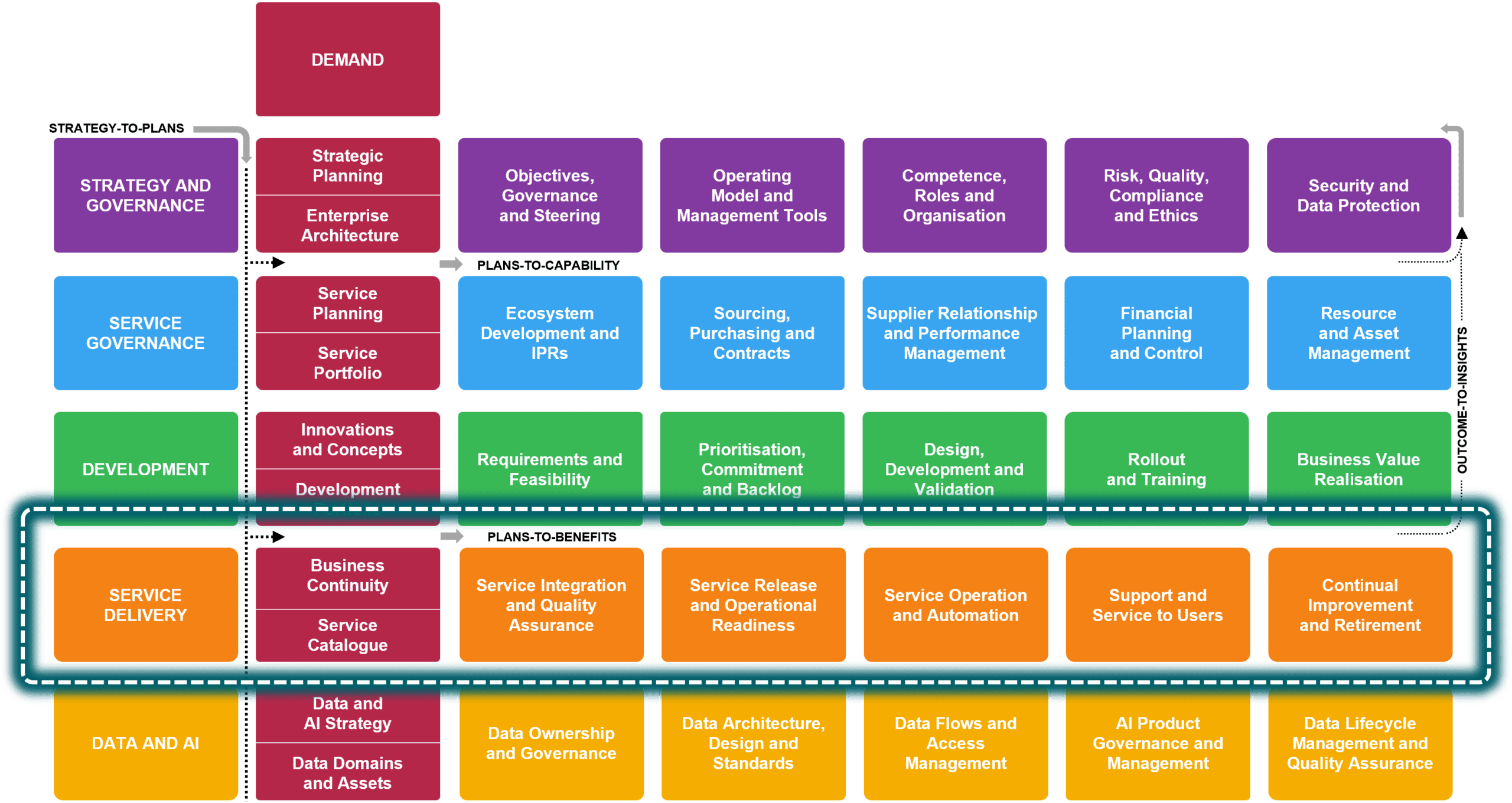
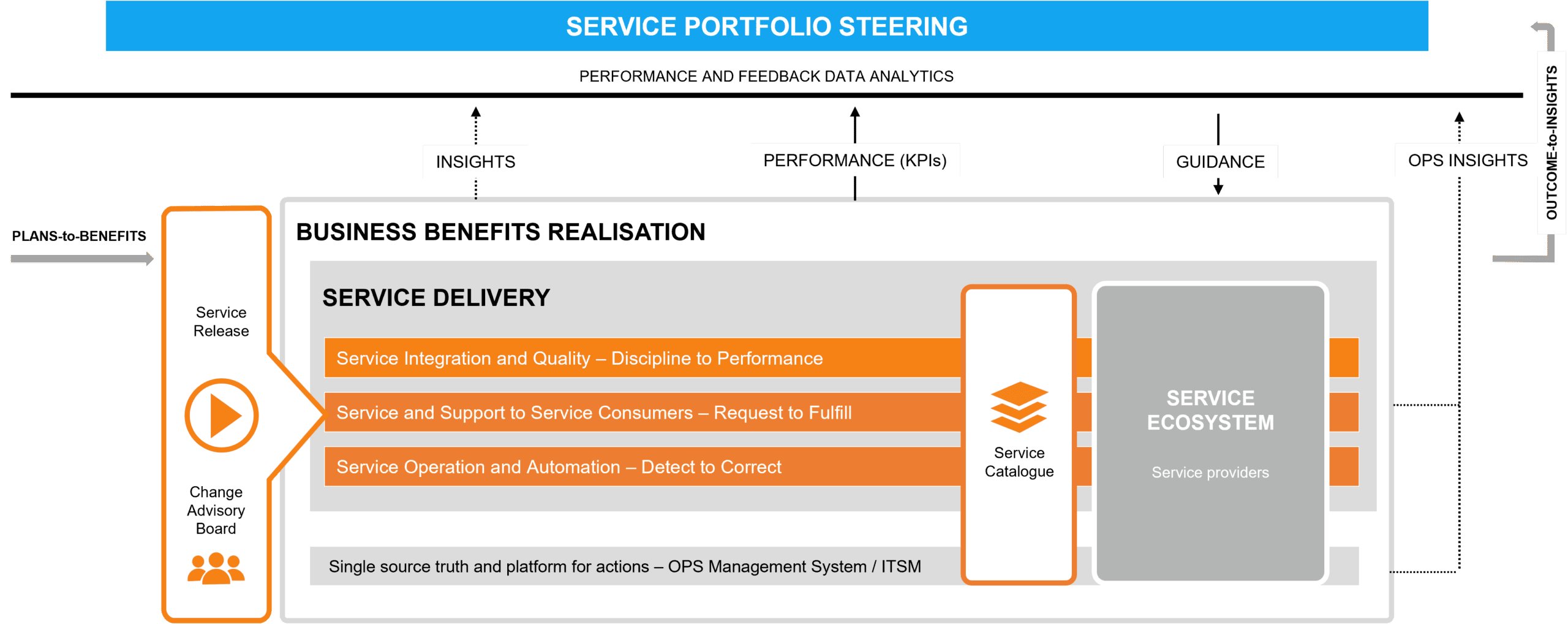
Service delivery is structured around five connected capabilities.
Service integration and quality assurance coordinate operational practices, operational quality, and cross-service visibility across the service ecosystem.
Service release and operational readiness ensure that new and changed services can be introduced into operational use safely and with sufficient operational preparedness and recovery capability.
Service operation and automation maintain continuous operations, operational resilience, operational protection, and highly automated runtime environments across global operational ecosystems.
Support and service to users enable productive service usage through operational support, self-service capabilities, automation, proactive guidance, and operational knowledge sharing.
Continual improvement and retirement ensure that services evolve, simplify, improve, and retire in a controlled and operationally sustainable way based on operational insight, service learning, and lifecycle optimisation.
Together, these capabilities ensure that services remain operationally effective, continuously improving, and aligned with changing business and operational conditions throughout their lifecycle.