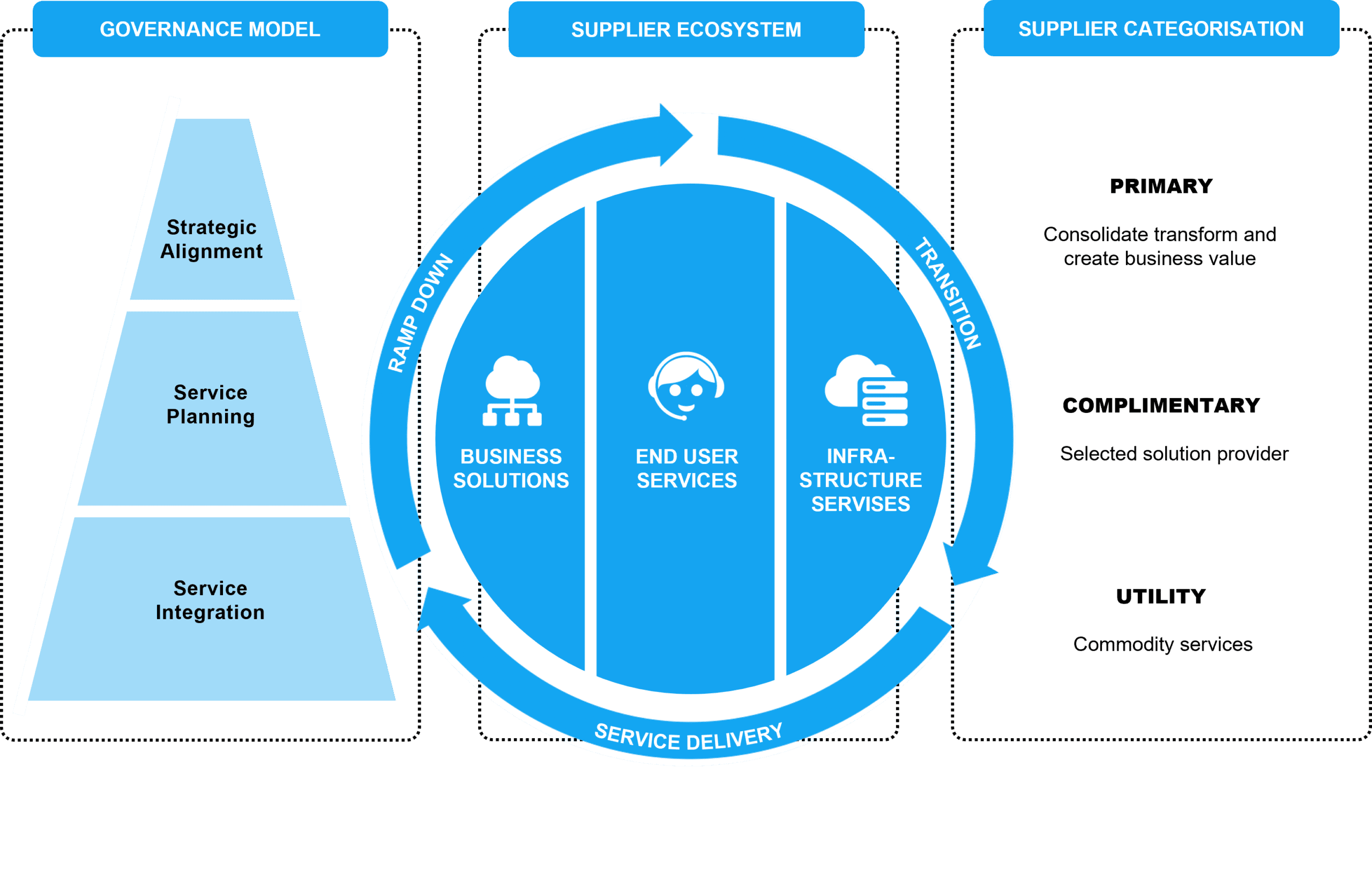
Supplier relationship and performance management ensures that external partners contribute effectively to business outcomes. It provides a structured approach to managing collaboration, performance, and development across the supplier ecosystem.
Service management and sourcing have distinct roles. Service Owners and Service Managers ensure that suppliers deliver value in line with service objectives, while sourcing ensures that relationships, contracts, and commercial conditions support long-term business goals.
The objective is to build a healthy and high-performing ecosystem that supports both current service delivery and future business needs. This capability includes relationship management, supplier categorisation, performance management, market watch and innovation, and contract lifecycle management.
Supplier relationship management focuses on maintaining effective collaboration through structured interaction. Service managers manage relationships through regular meetings that address service performance, costs, development plans, and opportunities to expand cooperation.
A structured approach is applied across three levels. At the operational level, the focus is on service performance follow-up, financials, SLA deviations and recurring operational issues. At the tactical level, the focus shifts to development planning and alignment over the coming months. At the strategic level, the focus is on long-term direction, including innovation opportunities and decisions on contract continuation.
Most effort is concentrated on the strategic and tactical levels, while operational follow-up is increasingly supported by service management systems.
Clear ownership is essential. Service managers typically manage relationships with business-critical suppliers, while service owners ensure alignment with service objectives and lifecycle needs. Sourcing supports governance and commercial alignment. Strategic relationships may also involve business owners or value stream owners to ensure alignment with business priorities.
Supplier categorisation provides the basis for managing relationships, risks, and performance effectively. Suppliers are classified across several dimensions, including service type, business criticality, risk exposure, and spend. These perspectives help identify suppliers that are critical for business continuity, transformation, or operational support.
From a value perspective, suppliers are also grouped as primary, complementary, or utility providers. Primary suppliers drive business value and transformation, complementary suppliers provide supporting capabilities, and utility suppliers deliver standard services. Categorisation determines the level of governance and collaboration applied to each supplier. Critical suppliers require closer interaction and stronger control, while less critical suppliers can be managed more efficiently.
Performance management ensures that suppliers meet agreed targets and deliver according to contractual expectations. It starts before engagement, where performance targets are defined and embedded in contracts. During delivery, performance is measured through service level agreements and key performance indicators and regularly reviewed. Operational supplier performance is managed through service delivery, while service governance uses the resulting information to support commercial, relationship and service lifecycle decisions.
Measurement is critical, as it directly influences supplier behaviour. Well-defined metrics create alignment, while poorly defined metrics may lead to unintended outcomes. Benchmarking against market standards supports cost and quality comparisons, and audit rights ensure control of supplier performance.
Operational supplier performance is managed through service delivery. Service governance uses this performance evidence to guide supplier relationships, commercial decisions and agreement lifecycle management. In many cases, performance depends on multiple suppliers. This requires coordination across providers to ensure that end-to-end service performance meets expectations.
Supplier management requires both an internal and external perspective. While performance reviews provide insight into current suppliers, organisations must also monitor the market.
Market watch involves understanding technology developments, supplier offerings, and emerging opportunities. At the same time, organisations actively engage with suppliers to explore new solutions, align roadmaps, and identify opportunities for improvement and innovation. Market watch also informs sourcing decisions, service roadmaps and renewal decisions by showing whether current suppliers remain the best fit for future needs.
The objective is to support service development and ensure that supplier relationships enable future capabilities. This includes verifying that contractual arrangements do not restrict development. Market watch and innovation are also part of the demand discipline, ensuring that identified opportunities are translated into actionable initiatives.
Contract lifecycle management ensures that supplier agreements remain aligned with service needs, performance expectations and relationship objectives. Contracts define performance expectations, commercial terms, responsibilities and governance practices. As services evolve, contracts must be reviewed and updated to reflect changing requirements.
Effective contract lifecycle management provides visibility into cost, performance, commitments and renewal points, enabling informed decisions such as renewal, renegotiation or termination. Clear contract ownership is essential, especially for critical services.