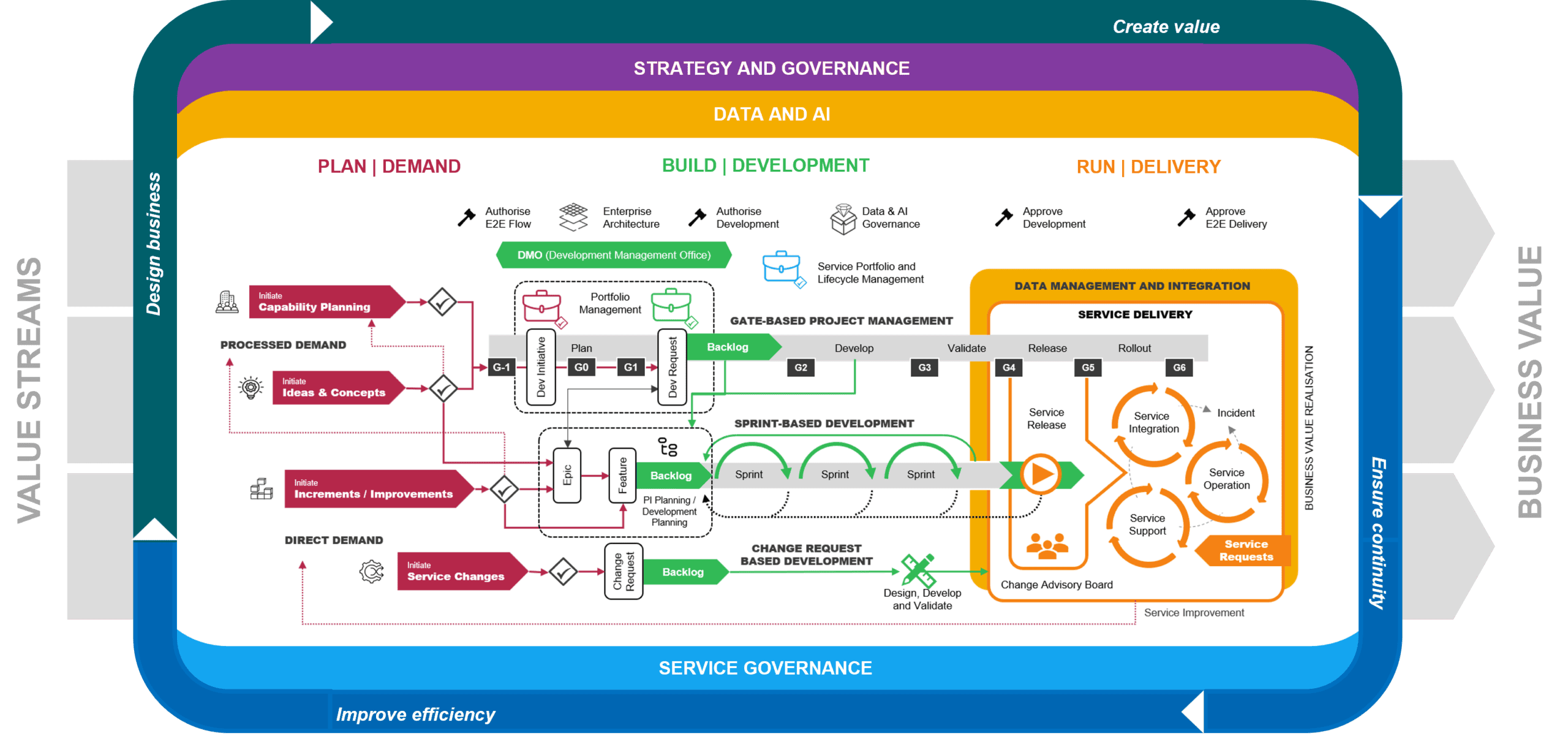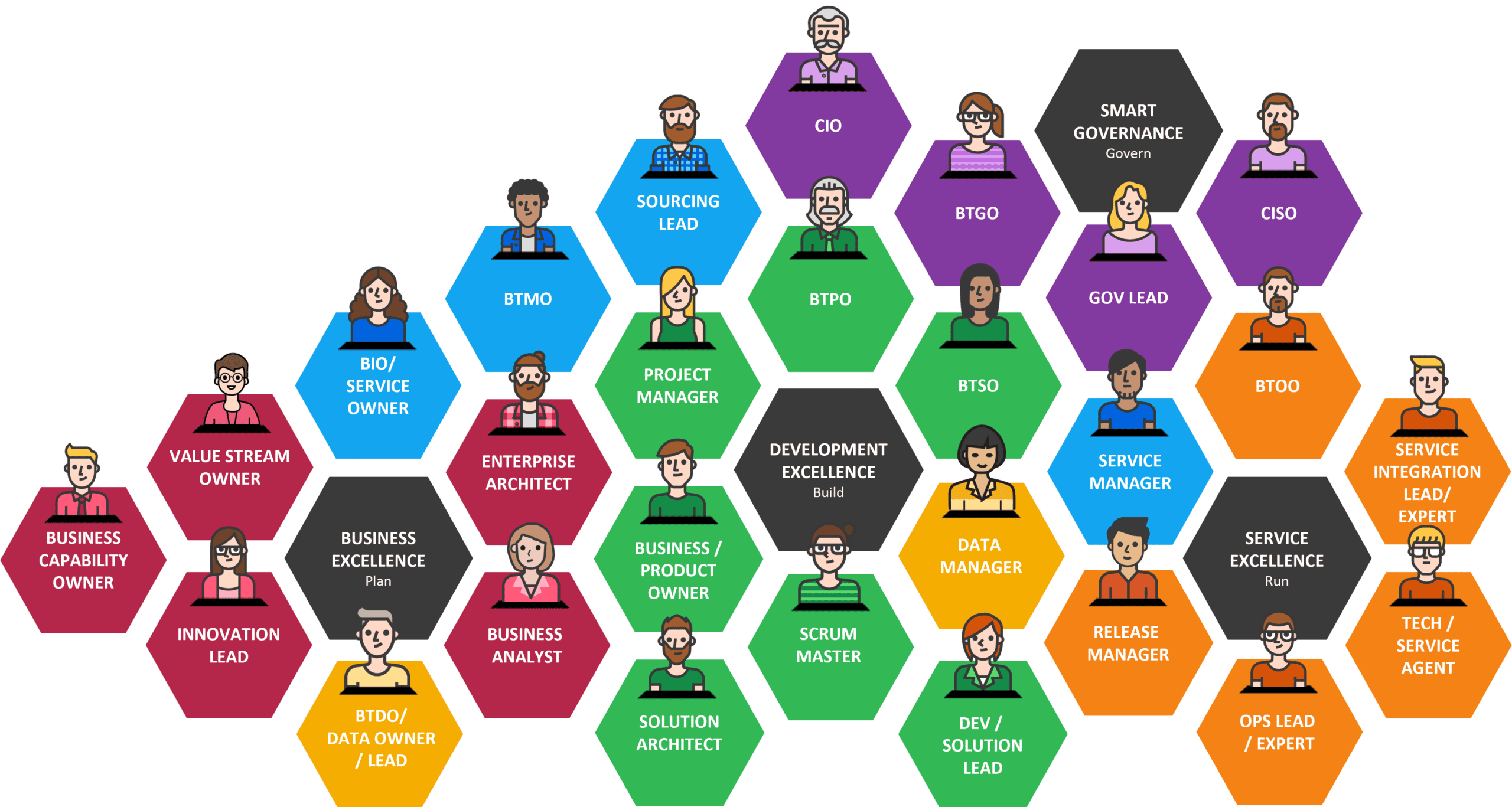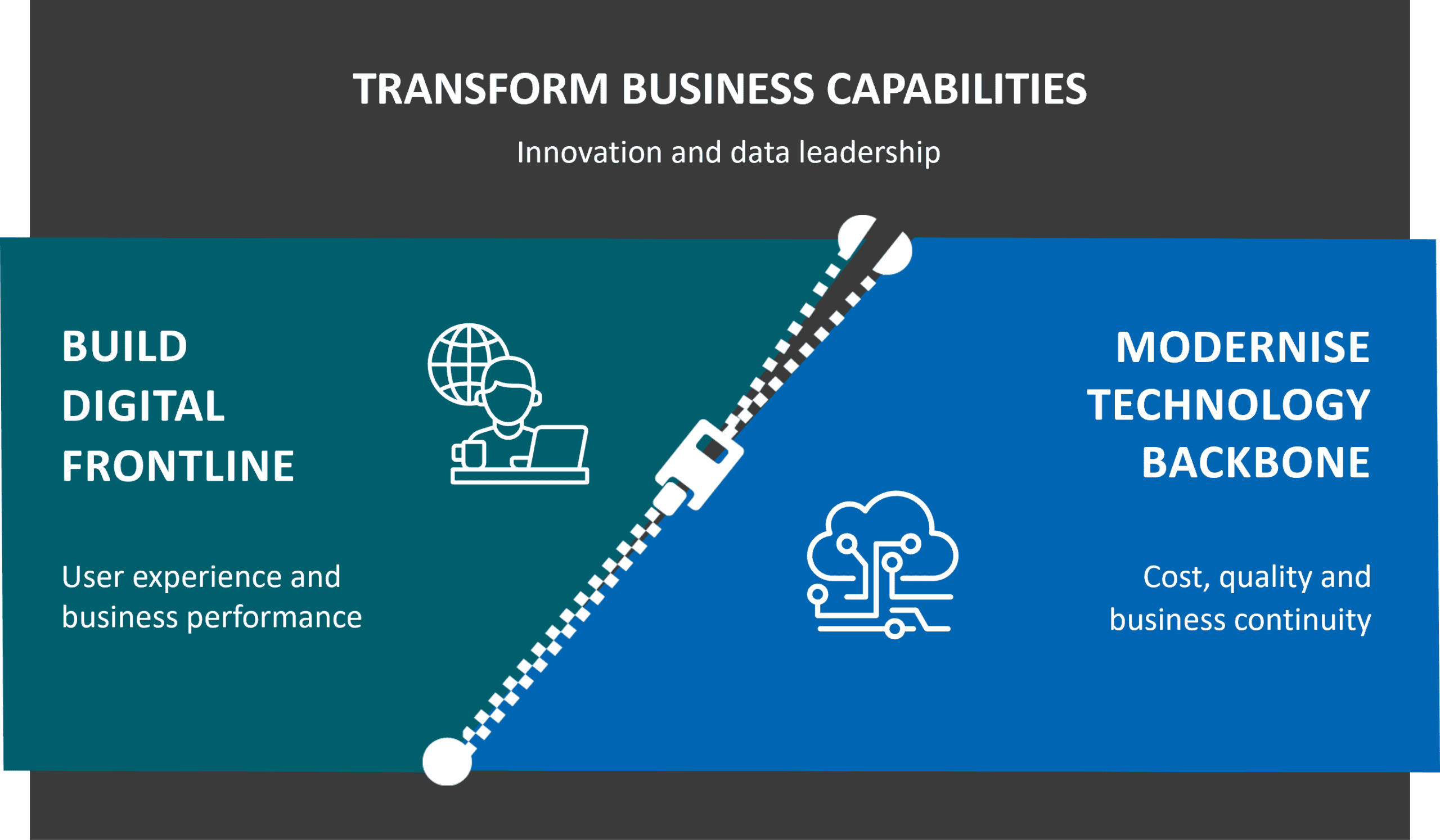
Business technology must be actively directed and steered to deliver business value. This is achieved through clear objectives, aligned governance, and effective steering across the organisation. Together, they ensure that business priorities are translated into focused development and reliable service outcomes.
Objectives define what the organisation aims to achieve and guide prioritisation and decision-making across business technology.
Objectives originate from business outcomes. These include impact on revenue and profitability, customer satisfaction, and overall business performance. Business technology supports these outcomes through its own objectives, such as faster time-to-value, cost efficiency, user satisfaction, service quality and availability, and development efficiency.
To align execution with strategy, organisations define strategic must-wins. These represent the most important priorities derived from business strategy and provide a clear direction for development and investment. Strategic must-wins are agreed at the enterprise level and guide all value streams.
Strategic must-wins connect strategy to value streams and portfolios, ensuring that development initiatives and requests are prioritised based on their contribution to business objectives.
Objectives are not a collection of metrics but a clear expression of direction. They provide a shared understanding of what matters and guide decisions at all levels of the organisation. Relevant measures connect objectives to prioritised demand, roadmap decisions and benefits management, maintaining a clear link between strategic intent, development priorities and expected outcomes.
Governance defines how decisions are structured and made across the organisation. Steering ensures that these decisions are actively taken and continuously adjusted based on business priorities and changing conditions.
Steering is an ongoing leadership activity. At the enterprise level, it provides direction, mandate, and resource allocation. At lower levels, it focuses on prioritisation, coordination, and execution. Supporting governance bodies ensure that key areas such as portfolios, services, architecture, and data remain aligned across the organisation.
Minimum viable governance (MVG) provides control and coordination while enabling speed and agility. Its purpose is to maximise business value by ensuring alignment with business priorities and coordination across value streams and end-to-end flows.
The minimum viable governance has the following elements:
Minimum viable governance has three levels: enterprise, value stream and E2E flow.
The enterprise governance level defines the overall operating model structure and governance across value streams and E2E flows.
The value stream level provides value governance across its E2E flows.
At the E2E flow level, development is managed according to the applicable context: project-based development, persistent product/DevOps development or smaller change-based development. The core development work remains consistent, while management and governance are adapted to the context.
Governance also ensures synergies across value streams, service lines and businesses. In practice, this means coordinated priorities, shared platforms and data, common architecture direction, reusable capabilities, consistent service and sourcing practices, and controlled dependencies. Without this, local optimisation can create duplicated solutions, fragmented data, overlapping services, inconsistent supplier ecosystems, and unnecessary cost and complexity.
Business technology governance operates across three connected levels: enterprise, value stream, and end-to-end flow. Each level has a distinct role in directing and delivering value, and together they ensure alignment from strategy to execution.
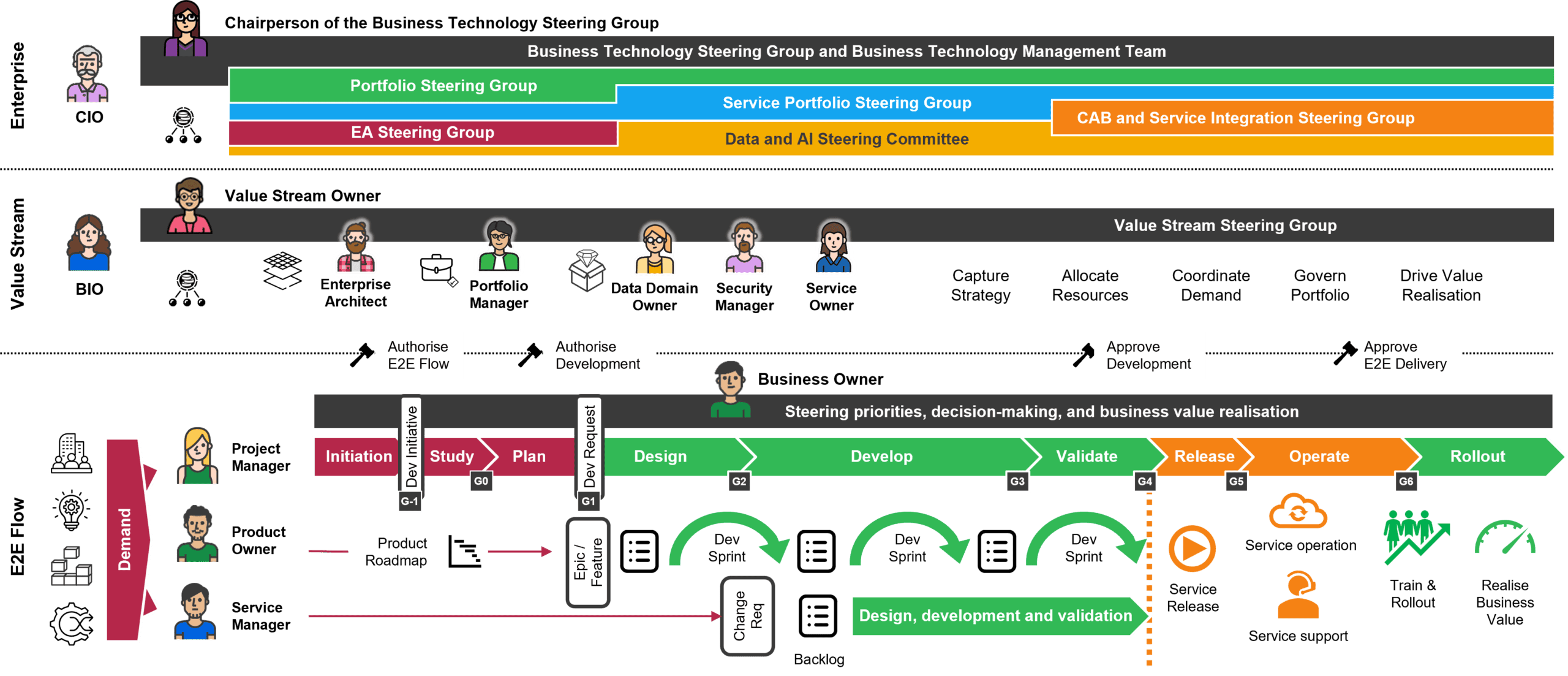
At the enterprise level, governance provides overall direction, alignment, and coordination across the organisation. Strategic must-wins and enterprise priorities are set at this level, and enterprise governance decides material financial and resource allocations and reallocations. Enterprise-level steering ensures that investments, architecture, data, services, and portfolios evolve in a consistent and synergistic way. Supporting steering bodies in areas such as portfolio, services, architecture, and data help coordinate cross-organisational decisions. The focus is on setting direction, resolving cross-value stream dependencies, and maintaining a balanced portfolio, without engaging in detailed execution.
At the value stream level, strategy is translated into focused development and service priorities. Each value stream is led by a Value Stream Owner and supported by a Business Information Officer (BIO) and operates as an active portfolio with its own steering group. Governance at this level prioritises demand and development, coordinates demand across business and technology, and directs the capacity available to the value stream towards the highest-priority work. It ensures that dependencies within and across value streams are managed and that development efforts are aligned with business objectives and available resources. This is the most critical level for steering, as it connects strategic direction with execution and ensures that the right initiatives are selected and progressed.
At the end-to-end flow level, governance ensures that work progresses through planning, demand management, development, release and rollout with clear accountability and decision points. The Business Owner remains accountable for the intended business outcome, while development is managed according to the applicable development context. Governance focuses on scope, risks, dependencies, solution quality and readiness for the next stage.
Together, these levels separate direction, prioritisation and execution while keeping them connected. Enterprise governance sets direction and enterprise-level commitments, value streams steer priorities and portfolios, and E2E flows progress work through the lifecycle towards business use and value realisation. This structure enables both alignment and agility, ensuring that decisions are made at the right level while maintaining a continuous flow of value creation.
Governance is implemented through a small number of clearly defined decision points in the end-to-end flow.
A Development Initiative authorises planning of a potential business change. A Development Request is the portfolio request to authorise development capacity and investment for a coherent set of one or more Outcome Requests. Outcome Requests remain the development work objects and progress through development according to the applicable context. Later decisions confirm readiness for release and, ultimately, completion of the intended E2E outcome.
These approval points ensure that resources are committed at the right time, risks are managed, and development remains aligned with business priorities.
Steering connects the three governance levels into a continuous flow of decision-making. At the enterprise level, steering sets direction, priorities and enterprise-level resource commitments. At the value stream level, it translates these into portfolio priorities and coordinates demand. At the E2E flow level, steering supports progression of approved work through Demand Management, Development, Release and Rollout.
Decisions are made at the lowest appropriate level to maintain speed and accountability. Escalation is used when wider coordination or enterprise direction is required.
The purpose of objectives, governance, and steering is to ensure that business technology delivers measurable business value.
Value is realised when new or changed capabilities are introduced, adopted and used in business operations to improve outcomes such as customer experience, efficiency and business performance. Business Owners remain accountable for the intended business outcomes and for ensuring that value realisation is followed after delivery.
Governance and steering provide the structure to guide decisions and execution, but success is measured by the impact on the business. By maintaining a clear link between objectives, decisions, and outcomes, the organisation ensures that business technology continuously supports its strategic goals.