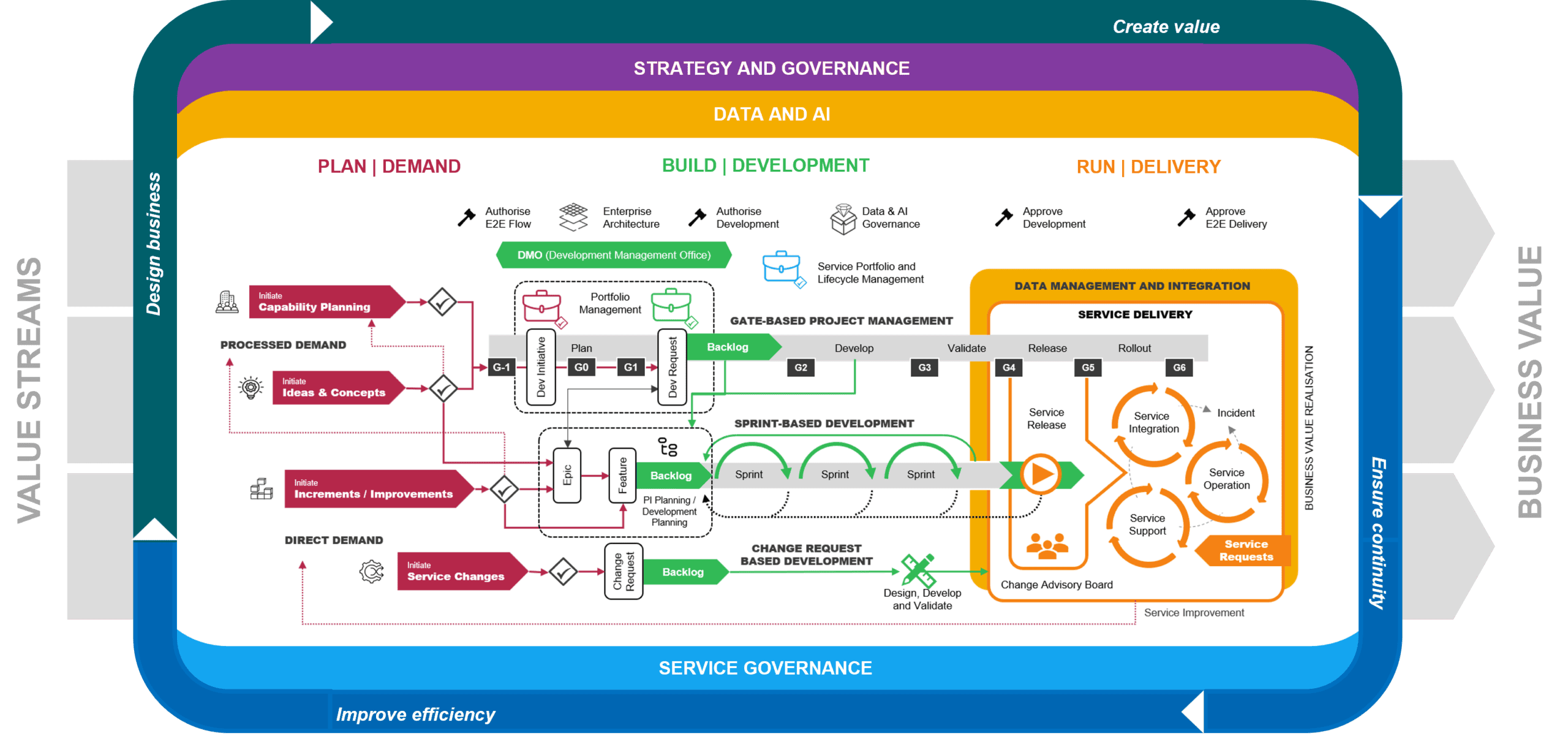
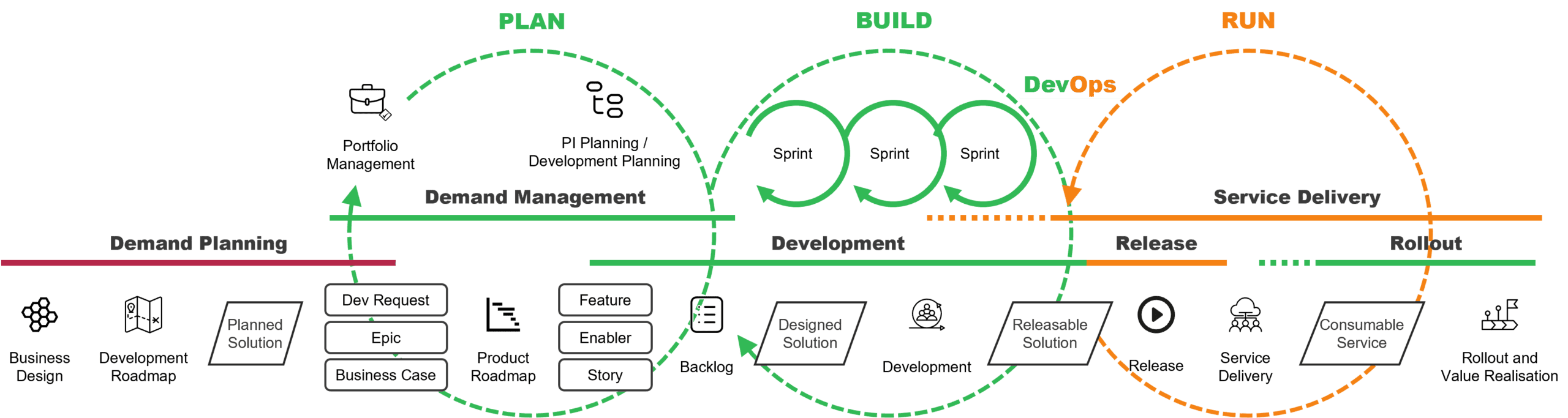
Once development work has been prioritised, committed, and refined into executable backlog items, the focus moves to turning business intent into working solutions that are ready for operational use.
Design, development, and validation form a continuous flow where solutions are shaped, implemented, refined, tested, and prepared for release. The objective is not only to complete development activities, but to ensure that the solution delivers the intended business outcome, operates reliably, and can be adopted successfully.
Once business intent, requirements, and feasibility have been defined, the focus shifts towards shaping a solution that can realistically be implemented, operated, and evolved.
Solution design combines multiple perspectives into a concrete implementation and operational model, including:
The objective of design is not only to define how the solution should work technically, but also how it should operate in practice, create business value, support users, and remain sustainable throughout its lifecycle.
Modern solution design is increasingly iterative and collaborative. Simulations, prototypes, process modelling, and AI-assisted design accelerate exploration and refinement of alternative solutions before implementation decisions are made.
At the same time, AI increases the speed and complexity of development. Although AI can support modelling, prototyping, and solution generation, effective design still requires human guidance, prioritisation, and decision-making across broad business and operational contexts.
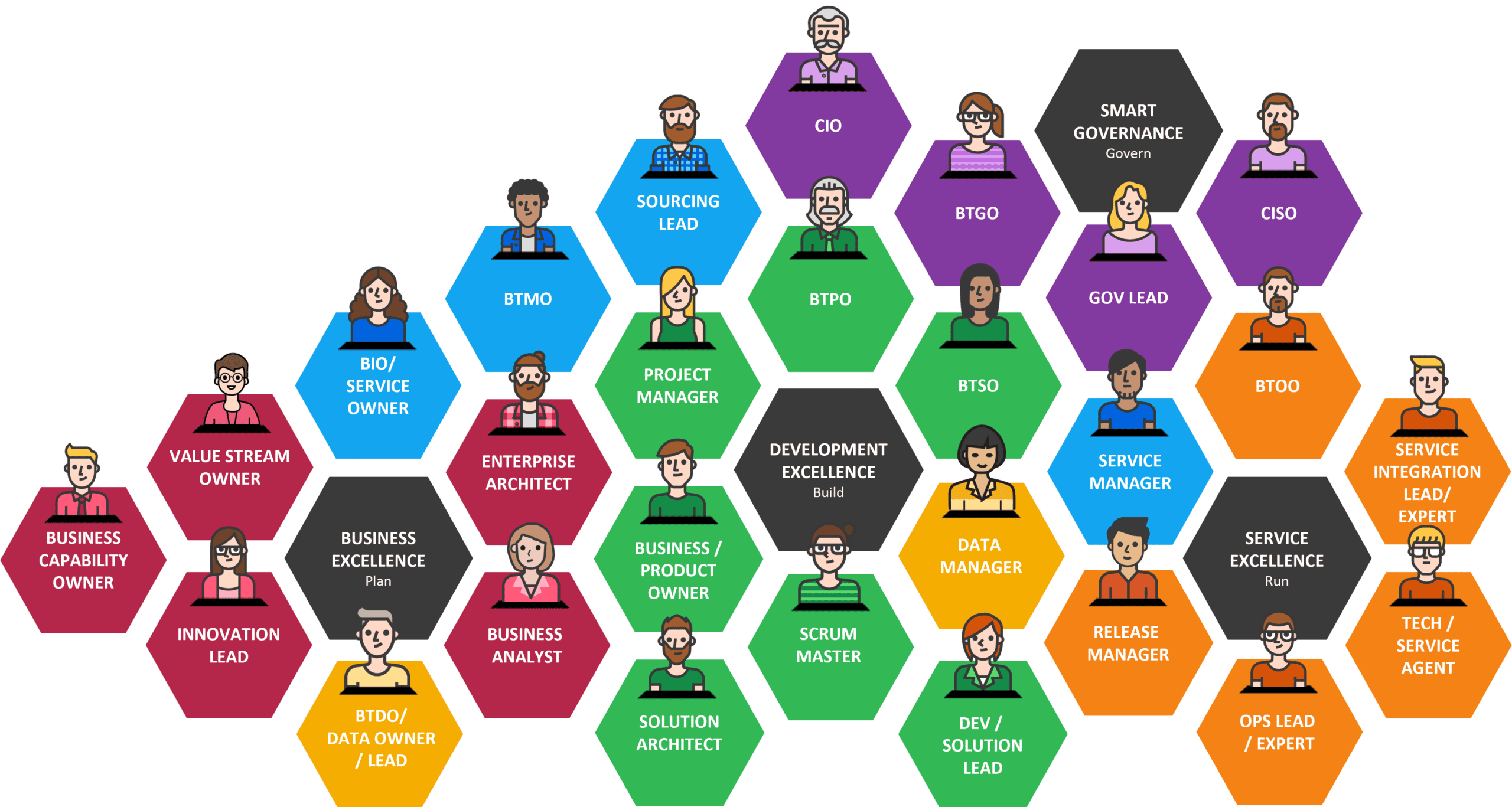
The Solution Architect ensures that the solution design supports business objectives, operational requirements, security, integrations, and long-term maintainability. The Business Capability Owner ensures that the planned solution remains aligned with business priorities and operational expectations throughout the development flow.
Different development needs require different management and governance arrangements, but the core solution development work remains broadly the same. Solutions are designed, developed, validated and refined iteratively, regardless of whether the work is managed through a project, a persistent product context or directly by a development team.
Project-based development adds an end-to-end management context when significant investment, broad organisational change, dependencies or coordinated rollout require stronger planning and governance. Project management provides the structure for managing scope, resources, dependencies, risks and business change across the wider development effort.
Product-based and team-based development provide persistent or lighter management contexts where development can progress continuously through prioritised backlogs, short development increments and regular feedback. A separate product management layer is used only when coordination across several teams or longer planning horizons adds value.
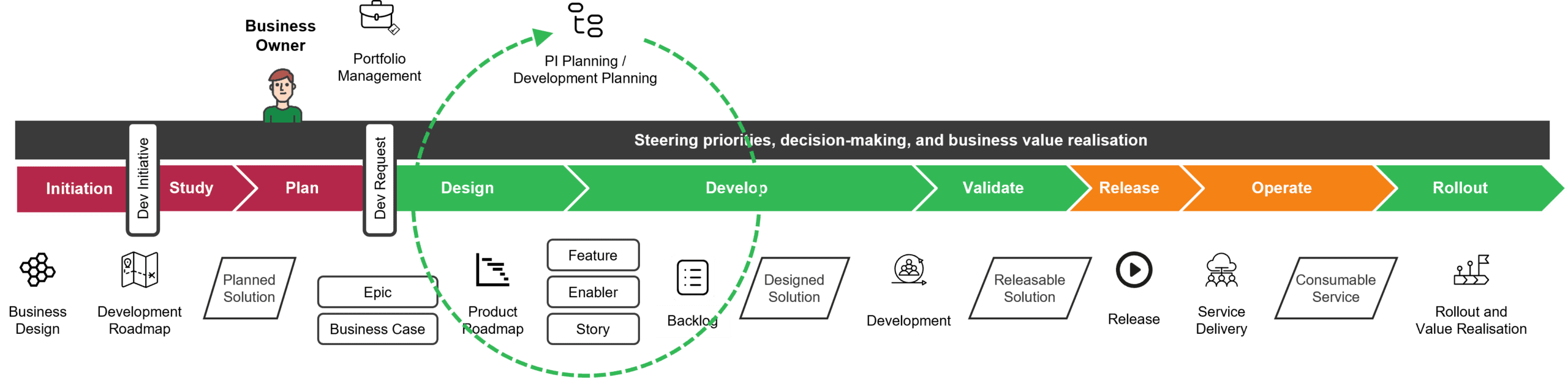
Within all of these contexts, development teams can use the same iterative practices for design, development, validation and refinement. The management and governance arrangements vary according to the scale, risk and organisational context of the work, rather than defining fundamentally different solution development methods.
Development planning coordinates dependencies, capacity and expected progress across the relevant project, product and team contexts. This allows development to remain iterative while maintaining the level of governance and coordination needed for the wider business change.
Validation ensures that the developed solution is ready for operational use and capable of delivering the intended business outcome.
Validation is not limited to technical testing. It confirms that the solution functions reliably within the business environment, supports operational processes, integrates correctly, meets security and compliance requirements, and can be adopted and supported effectively.
Validation may include:
A solution is not ready because development work is technically complete. It is ready when the organisation can operate, support, govern, and adopt the solution successfully.
Operational readiness becomes increasingly important as organisations rely more heavily on integrated services, automation, cloud platforms, AI capabilities, and external ecosystem partners. Operational readiness therefore requires close collaboration between development, service operations, business stakeholders, security, and support functions so that the validated solution can proceed to release.
AI introduces additional validation challenges. Unlike traditional software development, AI-based solutions are probabilistic and context-dependent, making them more difficult to prove consistently correct. Validation therefore focuses on whether the solution performs reliably enough within defined business, operational, security, ethical, and risk boundaries.
AI-enabled solutions also require continuous monitoring after release because model behaviour, data quality, usage patterns, and business conditions may change over time. Faster development cycles and AI-assisted implementation therefore increase, rather than reduce, the need for disciplined validation, operational readiness, and governance.
Artificial intelligence is significantly changing how solutions are designed, developed, and validated.
AI accelerates prototyping, testing, documentation, workflow generation, code generation, simulations, and scenario analysis. Solutions can increasingly be shaped through rapid experimentation, iterative refinement, and continuous stakeholder feedback rather than long specification and implementation cycles.
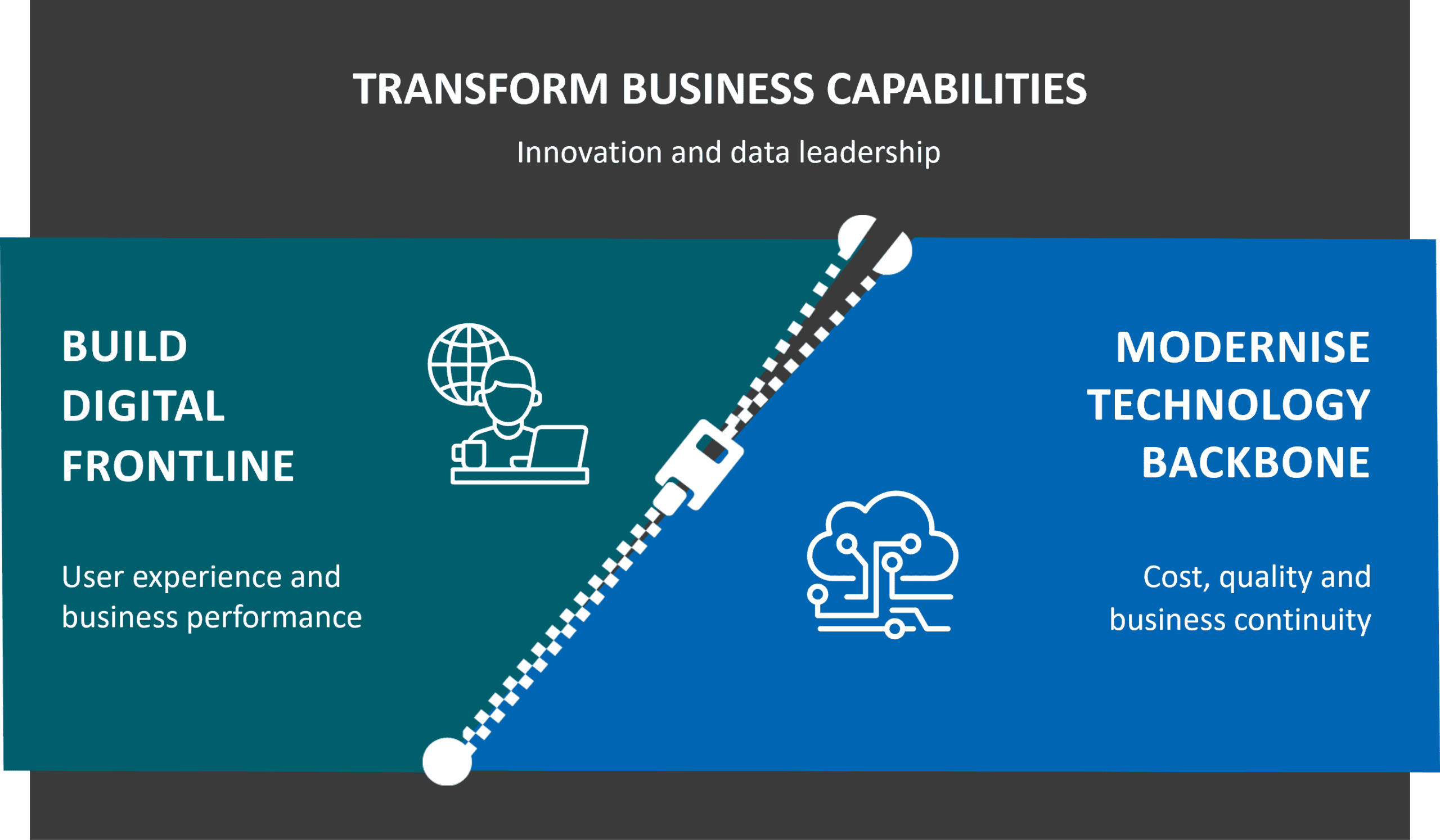
As development becomes faster and more descriptive, solution development also becomes less purely technical. This creates more room for business technology professionals who understand business operations and can translate business needs into working solutions with the support of AI, platforms, and development teams.
The speed of AI-supported development also changes expectations for delivery timelines and decision-making. Activities that previously required weeks may now take days, while work that previously required days may take hours. This increases organisational agility, but also requires stronger prioritisation, governance, validation, and operational discipline to maintain quality and control throughout the development flow.
From validated solution to consumable service
Once development and validation confirm that a solution is ready for operational use, it can proceed to release. Release introduces the releasable solution into the production environment and makes it available as a consumable service.
Release includes the final operational readiness checks, release validation, deployment and cutover execution, and the governance needed to control the transition into production. The specific arrangements depend on the scale, risk and nature of the change.
The Service delivery discipline describes release management and the associated practices in more detail.