A Data and AI strategy defines how data and AI contribute to the organisation’s business strategy and strategic priorities. It starts from the business outcomes, challenges and changes the organisation is seeking to achieve, and identifies where data and AI can help create tangible business value. Data, AI and technology capabilities are then developed to support these priorities in a controlled and sustainable way.
The strategy provides direction rather than detail. It aligns leadership expectations, guides investment, and establishes a common frame for decision-making across business and technology. Its purpose is not to promote technology, but to focus attention on business outcomes.
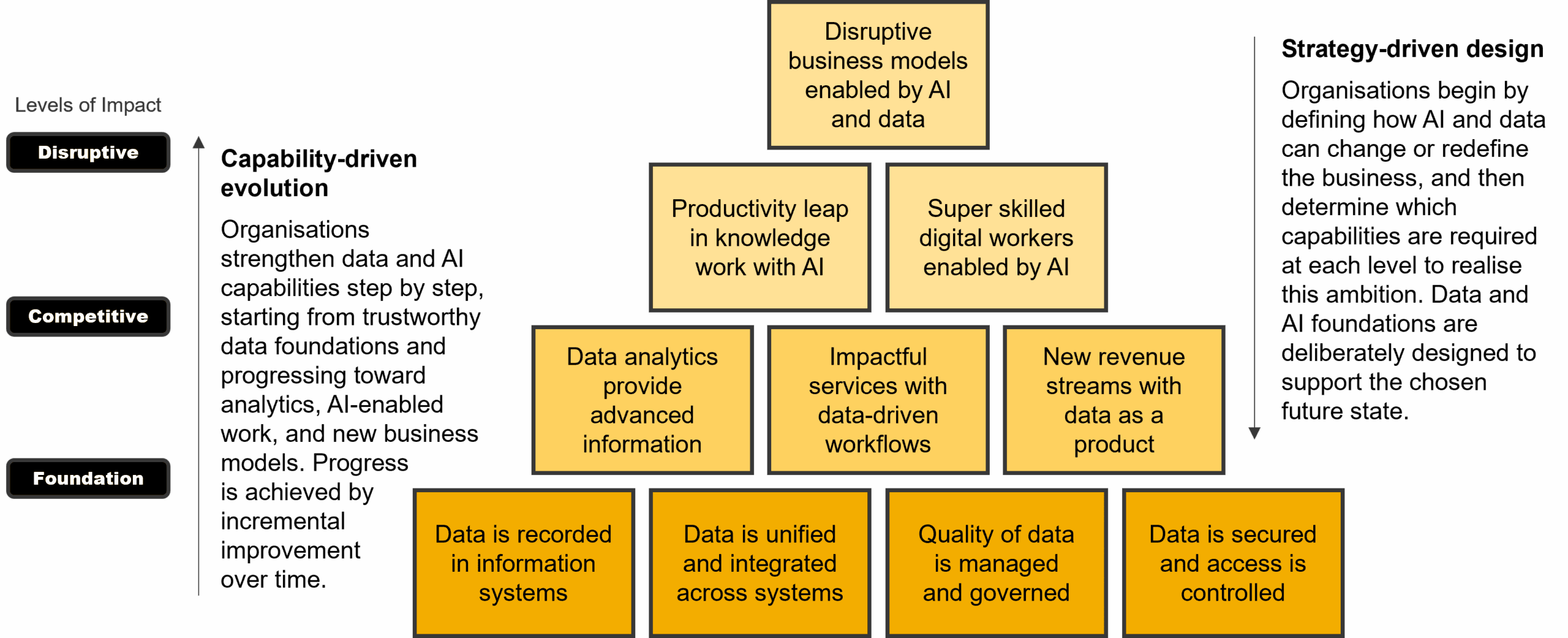
Data and AI do not create value on their own. Value is created progressively, building on a set of essential foundations and moving towards higher levels of business impact.
At the most basic level, data must be reliably recorded, integrated across systems, protected, and accessed in a controlled manner. These capabilities are not differentiators, but they are prerequisites. Without them, the organisation cannot operate efficiently or safely. For many organisations, this level represents a survival requirement.
Once these foundations are in place, data can be used more actively. Integrated and governed data enables advanced analytics, data-driven workflows, and the delivery of services that depend on timely and reliable information. At this level, data and AI support competitiveness by improving decision-making, service quality, and operational efficiency.
At the highest level of impact, data and AI enable step changes in how work is done and how value is created. Productivity in knowledge work increases through AI-supported roles. New digital services and revenue streams emerge where data is treated as a product. In some cases, entirely new business models become possible. This level is inherently disruptive and requires deliberate strategic intent.
Organisations approach data and AI strategy from one of two directions. Both are valid, but they lead to different priorities, risks, and outcomes.
Bottom-up planning starts from the foundations. The organisation focuses first on recording data reliably, integrating it across systems, managing quality, and controlling access. Advanced analytics and AI-enabled use are introduced gradually as these foundations stabilise.
This approach reduces risk and improves control. It is often chosen when data quality is uneven, governance is immature, or regulatory and security requirements are strict. The trade-off is speed. Business impact tends to emerge incrementally, and higher-impact use cases may be delayed.
Top-down planning starts from business impact. Leadership identifies where data and AI are expected to create competitive or disruptive value, such as productivity gains in knowledge work, new digital services, or data-based revenue streams. Required data, architecture, and governance capabilities are then built to support these ambitions.
This approach accelerates visible business value and helps align data and AI efforts with strategic goals. The trade-off is complexity. Without deliberate attention to foundations, quality, and access control, risks increase and scaling becomes difficult.
In practice, most organisations combine these approaches. Foundational capabilities are strengthened while selected high-impact initiatives are pursued deliberately. The role of the data and AI strategy is to make these choices explicit and to ensure that ambition, investment, and risk are aligned.
The data and AI strategy defines the key choices that guide how the organisation uses data and AI as part of normal business management.
It addresses the following areas.
The strategy clarifies the purpose of using data and AI. It defines which business decisions, activities, and services are expected to improve, and to what extent work is automated or augmented. The focus is on effectiveness, reliability, and scalability, not on technology adoption for its own sake.
Data is organised into data domains, each with a Data Domain Owner. AI capabilities may depend on those domains but retain their own accountable product, business or service ownership. The strategy defines which domains exist, how they relate to business capabilities, and where ownership is centralised or decentralised. Each domain has a named business owner accountable for outcomes, quality expectations, and appropriate use.
The strategy defines the governance and operating model for developing and using data and AI. It clarifies decision rights, roles, and ways of working across business, data, AI, and technology functions. Governance is embedded into everyday development and operations rather than treated as a separate control layer.
The strategy identifies the legal and regulatory requirements that apply to data and AI use, such as data protection, privacy, security, and sector-specific obligations. Business Owners remain accountable for compliance within their domains, supported by legal, risk, security, and governance functions.
The strategy guides investment towards durable capabilities rather than isolated use cases. It defines priorities for shared data foundations, domain-level data assets, analytical capabilities, and AI-enabled components. It also considers where value depends on data exchanged or combined with customers, partners, providers or external sources, including the ownership, access, quality and governance implications of these relationships. Investment decisions are made with a long-term view of reuse, maintainability, and risk.
The strategy identifies the organisational capabilities needed to realise value from data and AI. This includes the competence to understand and use data and AI effectively, leadership capability, adoption of new ways of working and the ability to manage changes in how people, processes and AI work together. The required capability development should reflect the organisation’s strategic ambitions rather than treating technology adoption as an objective in itself.
The strategy defines the objectives and measures used to assess whether data and AI are contributing to the intended business outcomes. Measures should connect strategic ambitions with observable changes in business performance, capability, adoption and value creation. More detailed measures and value-realisation evidence are defined and followed through the relevant planning, development and management practices.
Data has been recognised as a key business asset for years, but many organisations have lacked sufficient management pressure to improve data quality, clarify ownership and make business processes genuinely data-driven. The value potential has been understood, but improvement has often remained fragmented across reporting, system renewal, analytics initiatives or local data quality work.
AI changes this situation. When AI-enabled capabilities are used to support decisions, interact with users, automate work or initiate actions, weaknesses in data quality, ownership, access control and process discipline become visible much faster. Poor data no longer affects only reporting accuracy. It can directly affect recommendations, automated actions, customer interactions and operational outcomes.
This makes data and AI development inseparable. AI initiatives depend on reliable data foundations, while data initiatives gain stronger business relevance when they are connected to concrete AI-enabled use cases, automation opportunities and improved decision-making. Data quality, data ownership, process redesign and AI-enabled capability development therefore need to be treated as connected investment priorities.
Data and AI strategy provides the management frame for these choices. It defines where data foundations must be improved, where AI can create measurable business impact, which processes should become more data-driven, and how ownership, governance and investment responsibilities are organised. In this way, data and AI move from separate improvement topics into one business technology agenda for changing how work is managed, automated and improved.