The Key Term Glossary explains the core language of the Business Technology Standard (BTS) used throughout this book. The terms are presented in alphabetical order. Each entry defines the term in the BTS context and shows the primary discipline or perspective at the end in italics.
AI agent is an AI-enabled capability that can perform tasks, interact with users, support decisions, or participate in operational work with defined boundaries and supervision. In BTS, AI agents are treated as managed business technology capabilities that require ownership, access control, monitoring, service integration, and lifecycle management. [Data and AI]
Backlog is a prioritised set of committed development work that is sufficiently defined for planning, refinement, and execution. In BTS, the backlog is not a wish list, but a record of work that has moved from business intent towards implementation. [Development]
Business capability describes what the organisation must be able to do to achieve business outcomes. In BTS, business capabilities connect strategy, processes, data, technology, services, people, and ecosystems into a practical view of how the organisation creates value. [Demand]
Business design is the early shaping of business needs before development is committed. It defines the business rationale, capability change, user perspective, process impact, and development direction so that business intent is clear before solution work begins. [Demand]
Business technology is the integrated view of business and technology as one value creation capability. It recognises that technology is no longer only a support function, but part of business design, operations, services, data, AI, and competitive advantage. [Foundation]
Business Technology Operating Model defines how business and technology work together to create measurable business value. It connects roles, governance, capabilities, tools, decision points, and end-to-end flows into one coherent way of working. [Foundation]
Business Technology Standard (BTS) is an open operating model for co-creative business and technology development. It provides a common structure for aligning strategy, demand, development, service governance, service delivery, data, and AI into one value creation system. [Foundation]
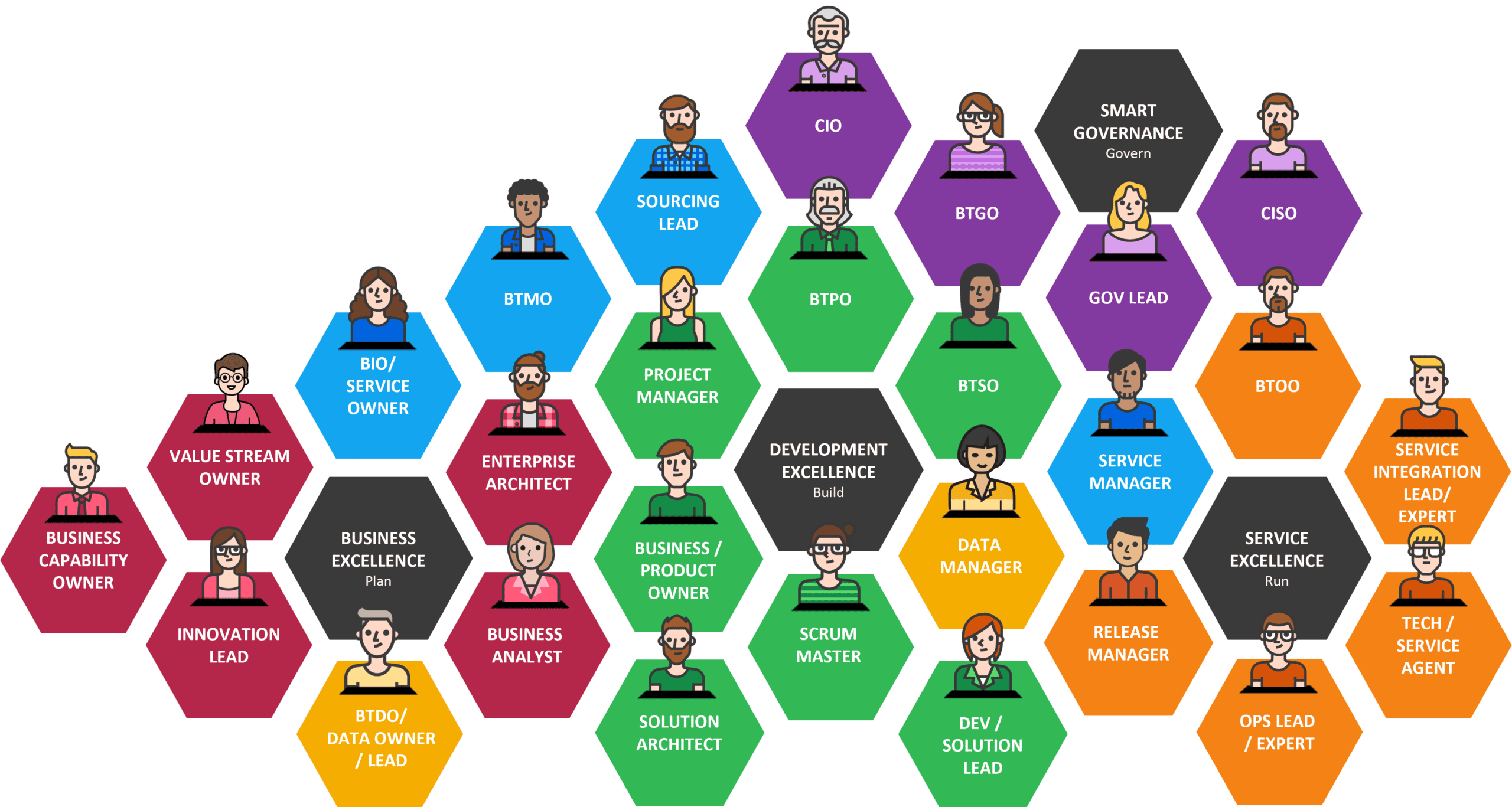
Business Technology x Officer (BTxO) is the common BTS naming pattern for orchestrator roles that make specific parts of the operating model work across the organisation. The “x” represents the focus area, such as Business Technology Governance Officer (BTGO), Business Technology Portfolio Officer (BTPO), Business Technology Management Officer (BTMO), Business Technology Solution Officer (BTSO), Business Technology Data Officer (BTDO) and Business Technology Operations Officer (BTOO); these are operating model roles, not necessarily job titles. [Strategy and Governance]
Business value is the measurable benefit created for the organisation, customers, users or society. In BTS, business value is the reason for business technology investment and is assessed through outcomes such as growth, efficiency, resilience, customer experience, sustainability, or public impact. [Cross-discipline]
Business value realisation confirms that delivered solutions create the intended business outcomes in real use. It shifts attention from completing delivery activities to ensuring adoption, operational performance, and measurable impact after rollout. [Development]
Capability is an organisational ability to perform an important activity repeatedly and reliably. In BTS, a capability combines roles, practices, competences, information, tools, and governance into something the organisation can depend on. [Foundation]
Capability Model is the main map of the BTS Capability Book. It shows the six BTS disciplines and the capabilities required to create, govern, develop, deliver, and improve business technology value. [Foundation]
Consumable service is a released service that users can access, use, and where they can receive support for daily operations. In BTS, a releasable solution becomes a consumable service only when release, operational readiness, support, and service consumption conditions are in place. [Service Delivery]
Data and AI is the BTS discipline that ensures data and AI are deliberately directed, structured, owned, governed, and improved as business assets. Its purpose is to turn information and intelligent capabilities into business value without weakening trust, accountability, or control. [Data and AI]
Data asset is a defined set of data with business value, accountability, and lifecycle needs. In BTS, data assets make data ownership practical by giving the organisation manageable units for quality, access, use, improvement, and investment decisions. [Data and AI]
Data domain is a stable area of data accountability, such as customer, product, employee, supplier, or finance data. In BTS, data domains provide a business-oriented structure for governing data across systems, services, analytics, and AI-enabled capabilities. [Data and AI]
Data governance is the set of structures, roles and practices that ensure data is trusted, protected, usable, and responsibly managed. In BTS, data governance is embedded in business technology work rather than treated as a separate technical control layer. [Data and AI]
Data ownership is business accountability for the meaning, quality, appropriate use and improvement of data. In BTS, every important data domain or critical data asset needs a clear owner so that accountability does not disappear into systems, teams, or platforms. [Data and AI]
Demand is the front end of value creation where business needs are identified, shaped, and prepared before development commitment. In BTS, demand ensures that business capability and technology solution development shape each other from the start. [Demand]
Demand management organises approved demand into executable development work while preserving business intent. It turns development requests into structured work such as project plans, epics, features, and backlog items. [Demand]
Demand planning is the business-led shaping of what needs to change, why it matters, and what outcome is expected. In BTS, demand planning happens before demand management and provides the business design, roadmap, and rationale needed for informed development decisions. [Demand]
Demand type is the BTS classification for different kinds of demand so that each receives the right level of planning and governance. BTS distinguishes capability planning, ideas and concepts, increments and improvements, service changes, and service requests, avoiding one generic process for all needs. [Demand]
Development is the BTS discipline that turns business intent into working solutions, operational capability, and measurable business value. It connects requirements, prioritisation, design, development, validation, rollout, training, and value realisation into one coherent flow. [Development]
Development initiative is an early approval object used to authorise planning, scoping, and business design before development commitment. It allows the organisation to invest enough effort to understand value, feasibility, and solution direction before requesting full development approval. [Demand]
Development request is the portfolio request to authorise development capacity and investment for a coherent set of one or more Outcome Requests. It brings together the planned solution, execution approach, business case and other commitments needed for the portfolio decision. [Demand / Development]is the formal request to authorise development based on sufficient business design, feasibility, and value rationale. In BTS, the development request acts as the handshake between demand planning and development execution. [Demand / Development]
Digital worker is a software-based or AI-enabled worker that performs defined operational or knowledge tasks. In BTS, digital workers must be governed as part of the operating model, with clear ownership, supervision, access rights, and service integration. [Data and AI]
Ecosystem is the network of partners, platforms, suppliers, providers, data ecosystems, and capabilities that support business technology value creation. In BTS, ecosystems are actively governed because they influence innovation, flexibility, cost, resilience, and long-term control. [Service Governance]
End-to-end flow (E2E flow) is the value creation flow from business need through development, release, service use, and business value realisation. In BTS, the E2E flow ensures that planning, development, and operations remain connected rather than managed as separate silos. [Cross-discipline]
Enterprise architecture is the capability that ensures business capabilities, processes, data, solutions, platforms, and ecosystems evolve coherently. In BTS, enterprise architecture gives demand structural quality and prevents local decisions from creating long-term business technology debt. [Strategy and Governance]
Minimum Viable Governance (MVG) is the BTS approach to governing business technology with the minimum set of decision points, roles and structures needed to keep value creation aligned, controlled and moving. It provides enough coordination to manage business value, risk, dependencies, and resources, while avoiding governance that slows ownership and delivery. MVG makes the right decisions visible at the right moments without turning governance into bureaucracy. [Strategy and Governance]
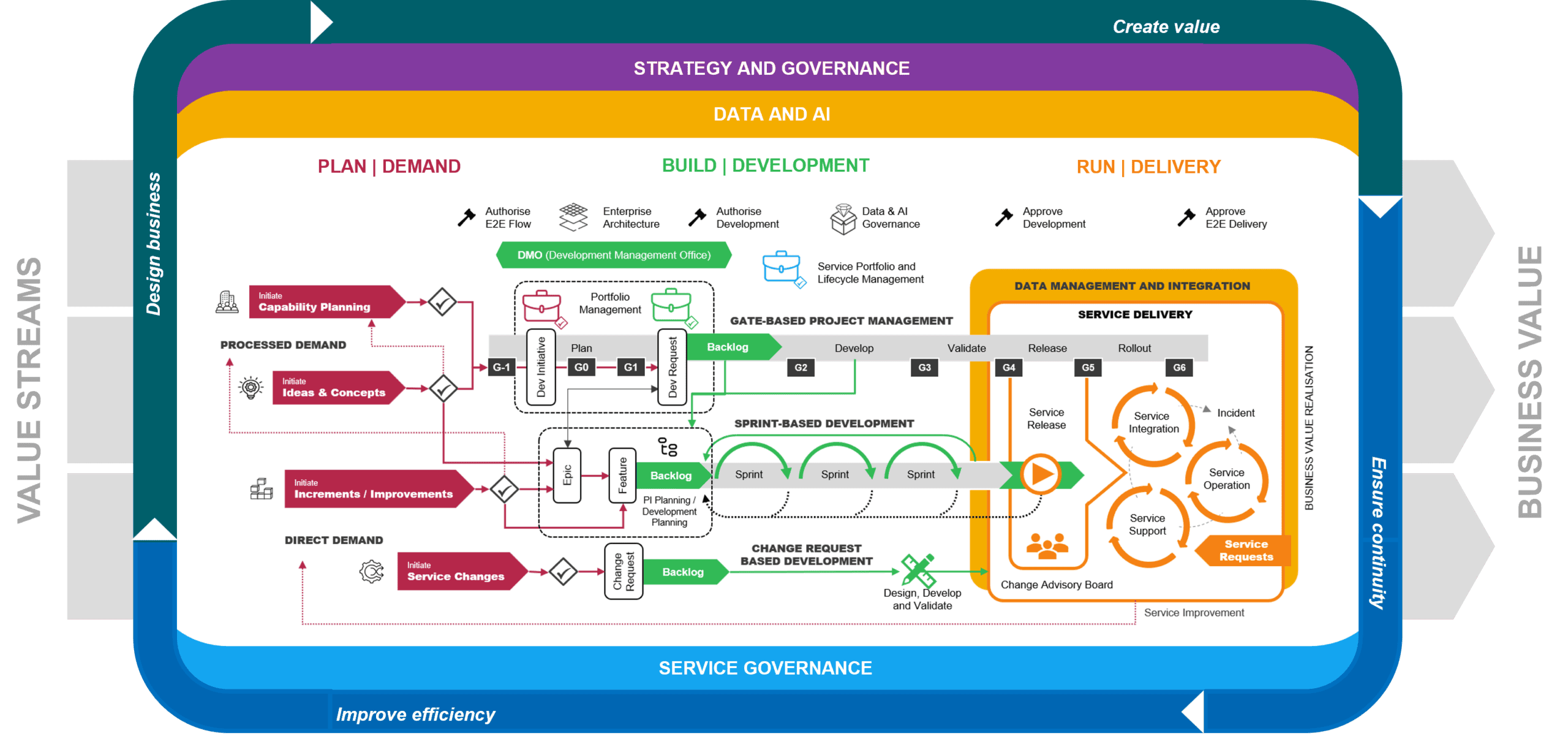
Operations Canvas is the operational view of BTS that shows the backbone needed to make value delivery reliable and sustainable. It makes visible the service management, release, support, integration, operations, and service consumption elements that are often hidden in value creation and governance models. [Service Delivery]
Operational readiness is the condition that a service can be monitored, supported, recovered, and operated reliably after release. In BTS, a technically deployable solution is not operationally ready until support models, continuity arrangements, ownership, monitoring, and recovery capabilities are in place. [Service Delivery]
Plan-Build-Run is the connected lifecycle from demand and planning to development, release, and service operations. In BTS, Plan-Build-Run is not a sequence of isolated handovers, but one integrated value creation system. [Cross-discipline]
Planning collective is a cross-functional group that shapes demand by combining business and technology perspectives. In BTS, planning collectives operate within value streams to create business design, roadmaps, and decision-ready development initiatives. [Demand]
Releasable solution is a developed solution that is functionally and technically ready to move towards release. In BTS, a releasable solution still needs operational readiness, release governance, and service preparation before it becomes a consumable service. [Development]
Roadmap is a time-oriented view of planned capability, product, service or data development. In BTS, a roadmap expresses prioritised intent and direction, but it is not yet the same as committed development work. [Demand]
Role identity is a professional identity grouping BTS roles by their contribution to value creation. BTS uses role identities such as Business Excellence, Development Excellence, Service Excellence and Smart Governance to clarify how people contribute across the operating model. [Strategy and Governance]
Service is a managed business technology offering that delivers value to users, business units or customers. In BTS, a service includes not only the technical solution, but also ownership, lifecycle direction, support, operations, cost, sourcing and user consumption. [Service Governance]
Service catalogue is the operational view of available services and standard service request paths. In BTS, the service catalogue helps users consume services in a controlled way and makes approved services, service requests and increasingly AI-enabled capabilities visible. [Service Delivery]
Service delivery is the BTS discipline that ensures services operate reliably, securely and effectively in daily use. It turns service commitments into operational reality through service integration, release readiness, operations, support, automation, learning and continual improvement. [Service Delivery]
Service governance is the BTS discipline that governs services, ecosystems, sourcing, suppliers, finances, resources, and lifecycle decisions. Its purpose is to ensure that services remain purposeful, economically justified, operationally viable and aligned with business priorities over time. [Service Governance]
Service integration is the coordination of services, providers, operational processes, and dependencies into one working service ecosystem. In BTS, service integration creates operational coherence across internal teams, suppliers, cloud platforms, automation, AI agents and support functions. [Service Delivery]
Service lifecycle describes the progression of a service from planning and development to operation, improvement, and retirement. In BTS, lifecycle management ensures that services are introduced, funded, evolved and retired deliberately rather than allowed to drift over time. [Service Governance]
Service portfolio is the management view of current, planned, changing and retiring services. In BTS, the service portfolio provides visibility into business criticality, lifecycle stage, cost, sourcing, dependencies, performance, and future direction across the service landscape. [Service Governance]
Sourcing ensures access to the right services, partners, platforms, and capabilities with suitable commercial control. In BTS, sourcing is not only purchasing; it is a value creation capability that balances flexibility, cost, innovation, risk, and long-term ecosystem control. [Service Governance]
Strategy and Governance is the BTS discipline that gives business technology direction, decision-making, coherence, risk control, and trust. It ensures that business technology is managed as one value creation capability rather than as disconnected initiatives, services, technologies, or control processes. [Strategy and Governance]
Strategic must-win is a critical strategic priority that guides business technology planning, investment, and steering. In BTS, strategic must-wins translate business ambition into focused priorities for value streams, demand planning, and portfolio decisions. [Strategy and Governance]
Time-to-value is the speed at which business needs become adopted, operational, and measurable business outcomes. In BTS, improving time-to-value means integrating demand, development, release, service delivery, and value realisation rather than accelerating only one part of the flow. [Cross-discipline]
Value Creation Model is the BTS flow view showing how business needs move towards realised business value. It connects business design, demand, development, release, service delivery, and business value realisation into one end-to-end picture. [Cross-discipline]
Value governance approval point is a key BTS decision point where value, commitment, readiness, or delivery is approved. In Minimum Viable Governance (MVG), these approval points make important decisions visible without creating unnecessary governance layers. [Strategy and Governance]
Value stream is a focused portfolio and steering structure aligned to a business area or value objective. In BTS, value streams keep decision-making close to business priorities and provide the main structure for managing demand, development and value realisation. [Cross-discipline]