Data lifecycle management and quality assurance ensure that data remains reliable, relevant and fit for purpose over time. As data increasingly supports operational execution, automation and AI-enabled services, unmanaged lifecycle transitions or declining data quality introduce direct business risk and reduce confidence in decisions.
Data does not remain valid by default. Business models evolve, services change and regulatory expectations develop. Managing data as a business asset therefore requires deliberate lifecycle management combined with continuous quality assurance, embedded into normal operations rather than treated as a one-time activity.
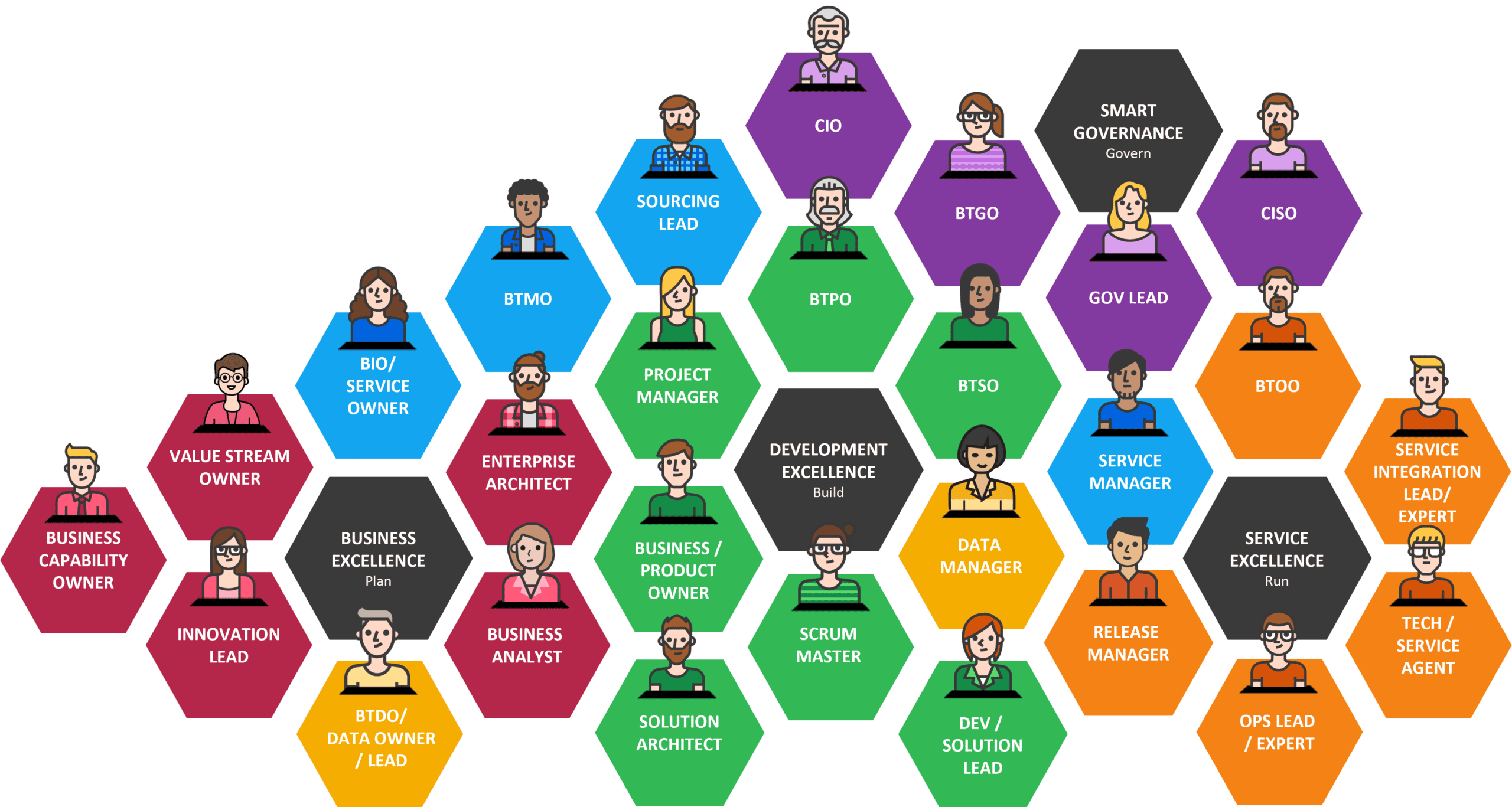
The Data Owner remains accountable for data fitness for purpose, quality expectations and lifecycle decisions. The Data Manager supports this by coordinating maintenance, monitoring, issue analysis and improvement actions. Together, these roles ensure that data is actively managed throughout its lifecycle rather than only corrected when problems appear.
Managing data across its lifecycle means managing it as a continuously evolving business asset, not as a static by-product of systems or projects. Data is introduced, designed, operated, improved and eventually decommissioned through normal business and technology activities, and lifecycle management must be embedded into these flows.
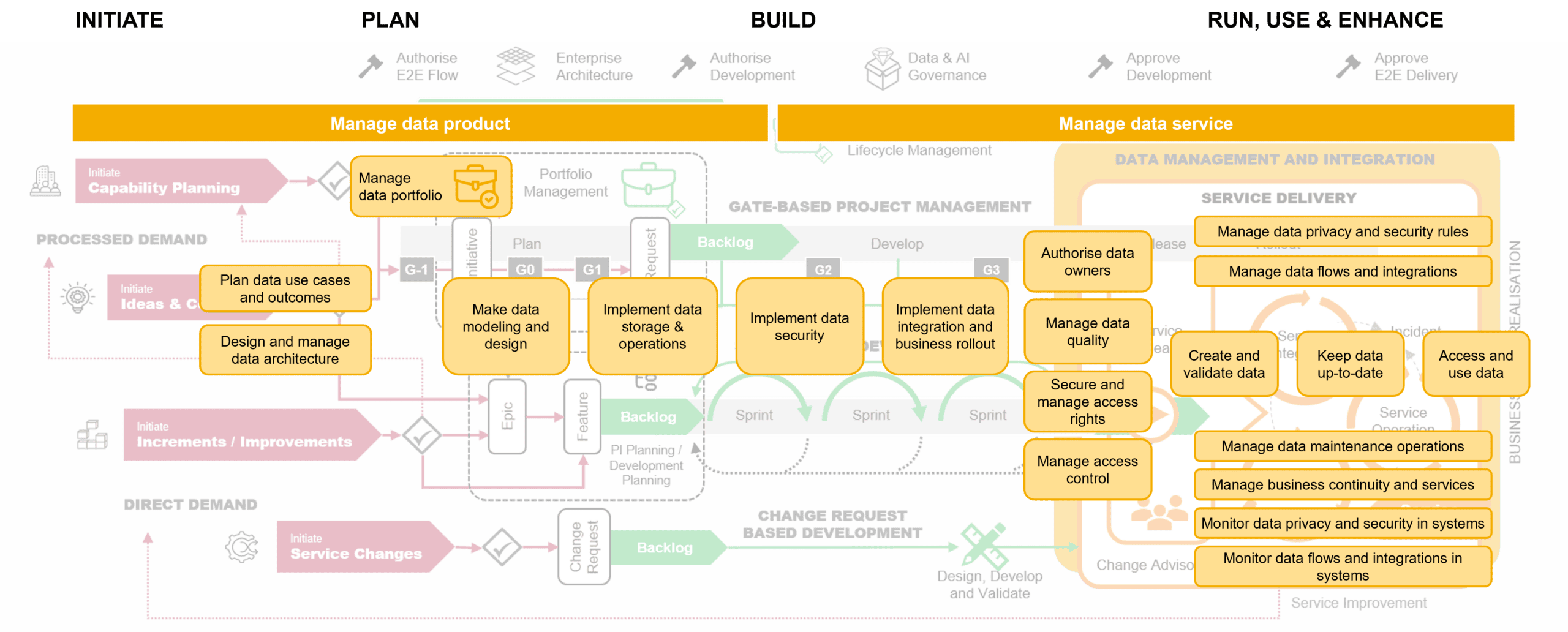
At the start of the lifecycle, data management is driven by business demand. New or changed data assets emerge from capability planning, service changes, regulatory requirements or improvement initiatives. At this stage, the organisation defines the purpose of the data, expected outcomes, ownership, and high-level quality and usage expectations. This ensures that data is introduced deliberately rather than accumulating as an unintended side effect of development.
As data moves into design and implementation, lifecycle management focuses on modelling, architecture and technical realisation. Data structures, integrations, storage and security are implemented as part of normal development work. Ownership, access rights and privacy requirements are established early, so that controls are built in rather than added later.
Once data assets are in active use, lifecycle management shifts to service-oriented operation. Data is created, accessed, shared and updated as part of everyday business processes. Ongoing activities include managing access control, monitoring data quality, keeping data up to date, and ensuring that flows and integrations continue to operate as intended. Data maintenance and quality management are continuous responsibilities, not one-time tasks.
Lifecycle management also includes continuous improvement. Data usage, quality and business relevance are reviewed regularly. Issues are addressed through incremental improvements, and data assets are adapted as business needs, services and regulations evolve. These improvements follow the same change and delivery practices as other business and technology changes.
Finally, lifecycle management covers controlled decommissioning. When data is no longer needed, its use is intentionally reduced, dependencies are removed, and data is archived or disposed of in line with legal, regulatory and business requirements. Even at end of use, ownership and accountability remain in place to ensure traceability and compliance.
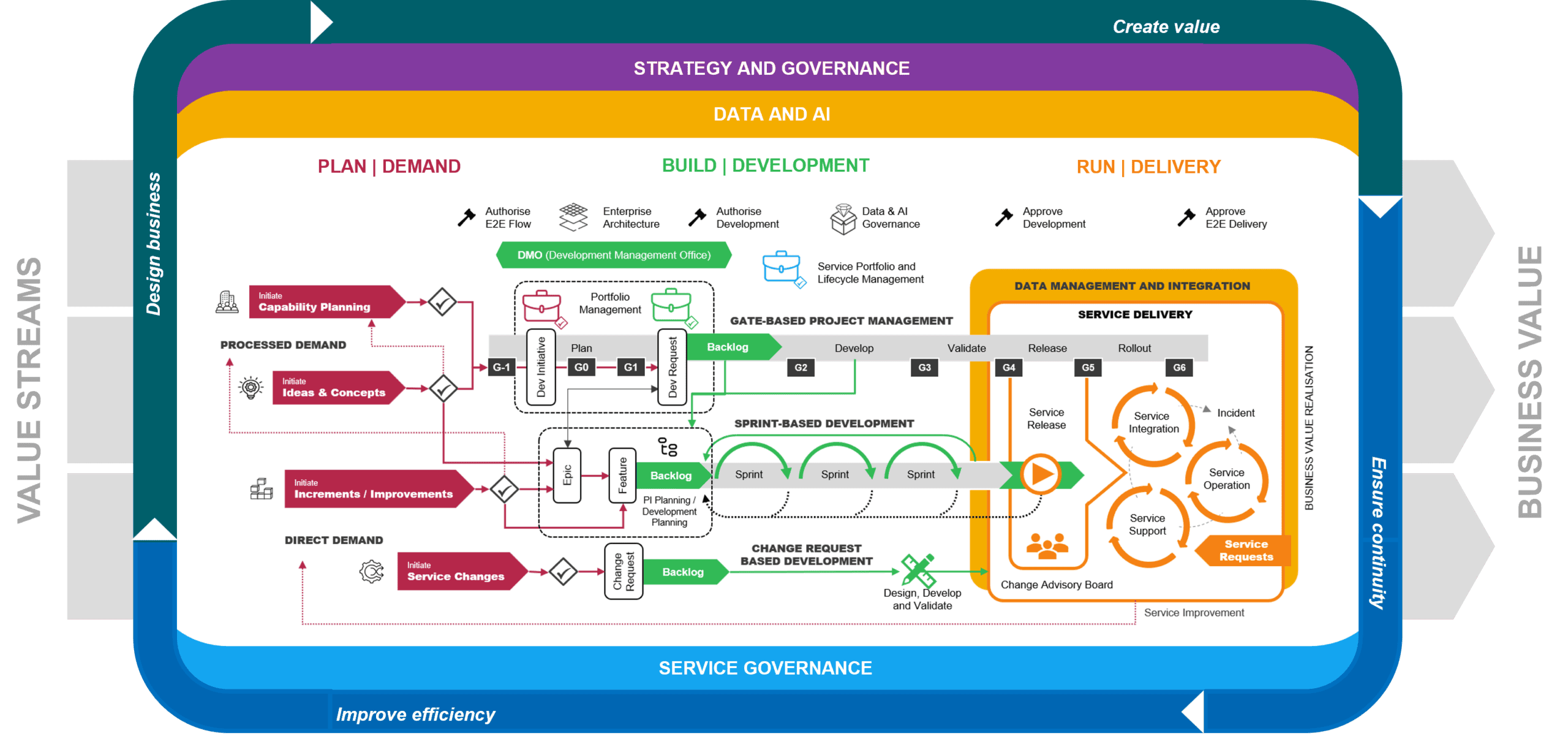
By embedding lifecycle management into portfolio planning, development, service delivery and operations, the organisation ensures that data remains purposeful, reliable and governed throughout its existence. This prevents unmanaged data growth, reduces operational risk and supports sustainable use of data across systems, services and AI-enabled capabilities.
Data quality is not a static attribute and not a technical concern alone. It is a continuous business responsibility that applies throughout the data lifecycle. Data quality is sufficient when data is fit for its intended use by defined data consumers.
Quality expectations are defined at both data domain and data asset level, based on how the data is used. Data Domain Owners ensure that common quality expectations and priorities are coherent across the domain, while Data Owners define and maintain the requirements for their assigned data assets. These expectations may address dimensions such as:
Not all dimensions apply equally to all data assets. What matters is that quality requirements are explicitly linked to business purpose, operational risk and the level of reliance placed on the data.
Data Owners remain accountable for ensuring that data continues to meet business needs as those needs evolve. Data Managers and other supporting roles contribute monitoring, analysis and improvement activities, but accountability for fitness for purpose remains with the business.
As reliance on automated processing and reuse increases, unresolved quality issues tend to propagate across systems, services and processes. Early detection and timely corrective action are therefore essential. When data is used in AI-enabled capabilities, quality issues may also affect recommendations, automated actions and customer interactions, making quality assurance a direct part of business control.
Data quality assurance is embedded into development and operations rather than treated as a separate compliance activity. The objective is to prevent quality issues at the source and to ensure trust between process steps.
Quality assurance follows two core principles:
In practice, quality assurance includes:
Corrective actions address immediate issues and correct data at the source. Preventive actions focus on root causes, such as unclear instructions, inadequate training, missing validations or structural data problems. Both are part of normal business governance.
Lifecycle management and quality assurance are governed through existing business and data governance structures. Data quality status and trends are part of regular governance agendas and are supported by transparent metrics.
Data Owners are responsible for making quality visible and for prioritising investments where quality issues create operational risk, inefficiency or compliance exposure. Data Domain Owners provide direction where quality issues, dependencies or investment priorities span several data assets within the domain. Data Managers support this by analysing quality issues, coordinating corrective and preventive actions, and maintaining quality practices in daily operations.
Where appropriate, lifecycle controls and quality checks are automated. Automated validation, retention, archiving and monitoring improve consistency, reduce manual effort and support traceability, auditability and security objectives.
Automation does not remove accountability. It makes quality control more scalable, but the organisation must still define quality expectations, monitor exceptions, investigate root causes and decide when investment is required. This ensures that data remains reliable enough to support business processes, services, automation and AI-enabled work throughout its lifecycle.