Innovations and concepts form a specific type of business technology demand focused on exploring new opportunities, challenging existing ways of working, and testing emerging ideas before committing to larger capability planning or development. Within the Business Technology Standard, this capability provides a controlled but fast-moving path from early ideas to validated concepts that can be assessed for further investment.
This type of demand is used when business needs are unclear, novel, or exploratory in nature. The objective is to learn quickly whether an idea has sufficient business potential to justify further development through capability planning, a development initiative, or direct transition into development. Ideas that do not show enough potential are stopped early, allowing attention and resources to move to stronger opportunities.
Innovation does not have to be something radically new or disruptive. It often emerges from everyday improvements, small adjustments, or new combinations of existing activities that create measurable business value. A simple AI analysis can improve decision-making, a new way of organising work can reduce lead times, and better use of data can reveal opportunities that were previously difficult to see. The focus is on practical outcomes rather than novelty, ensuring that ideas remain grounded in real business needs.
AI changes how innovation and concept work is carried out. It makes experimentation faster, cheaper, and more incremental to business capability planning and solution planning. Ideas can be explored through simulations, rapid prototypes, process analysis, customer interaction models, and data-driven experiments while the capability or solution direction is still being shaped.
This strengthens innovations and concepts as a continuous learning practice. Early concepts can be tested, refined, narrowed, or stopped before larger planning or development commitments are made. Validated findings can feed directly into capability roadmaps, development initiatives, solution options, and feasibility assessment.
AI-assisted experimentation does not replace business judgement. It increases the number of alternatives that can be explored, but it also requires clear ownership, data boundaries, responsible use, and disciplined validation. The objective is not to experiment more for its own sake, but to improve the quality of demand before the organisation commits development capacity.
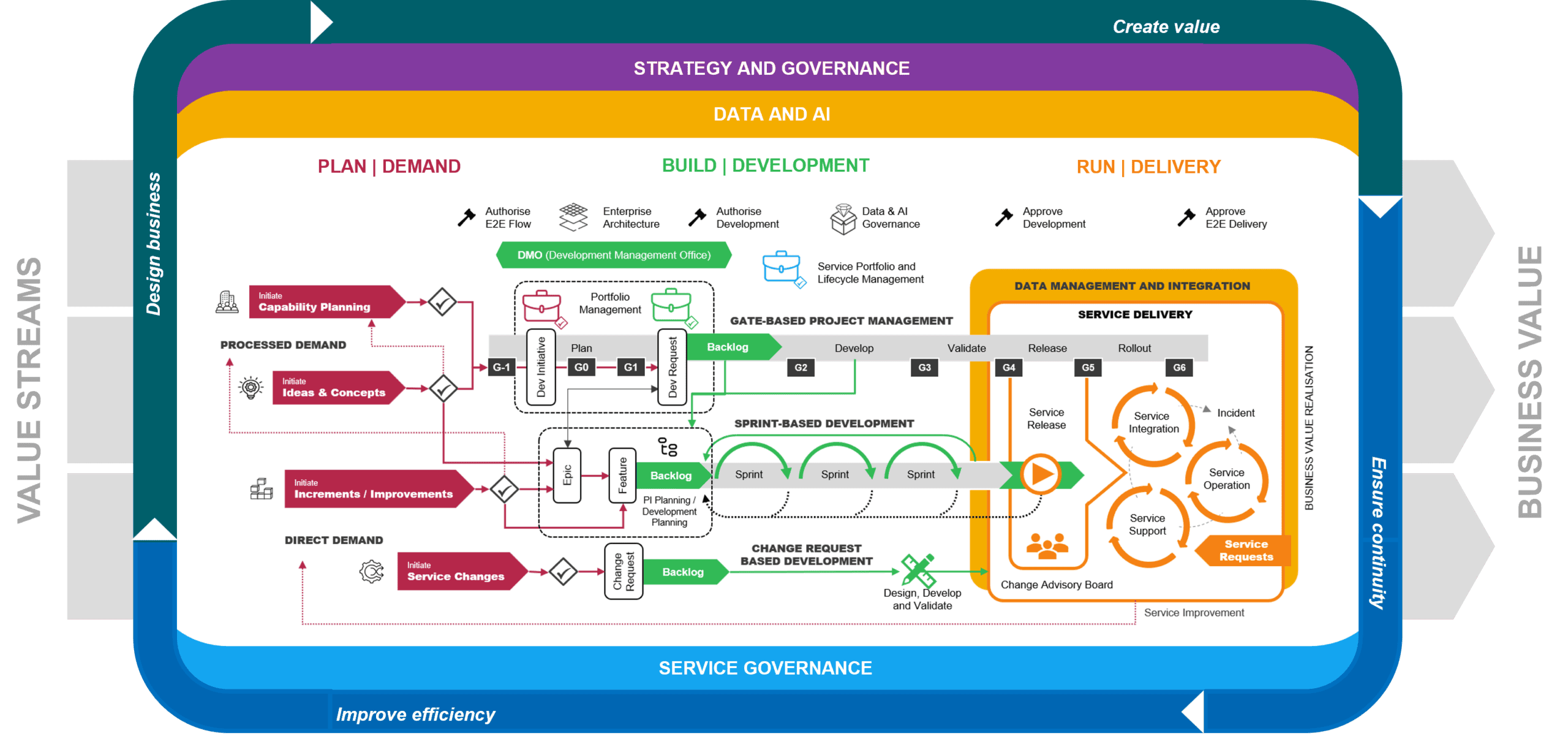
The innovations and concepts capability is closely linked to demand planning and management. Ideas are captured, refined, and evaluated as processed demand. Promising ideas are shaped into concepts that describe the business rationale, expected outcomes, high-level solution approach, key constraints, risks, and dependencies. The outcome is typically a development initiative proposal that can be assessed within the demand portfolio.
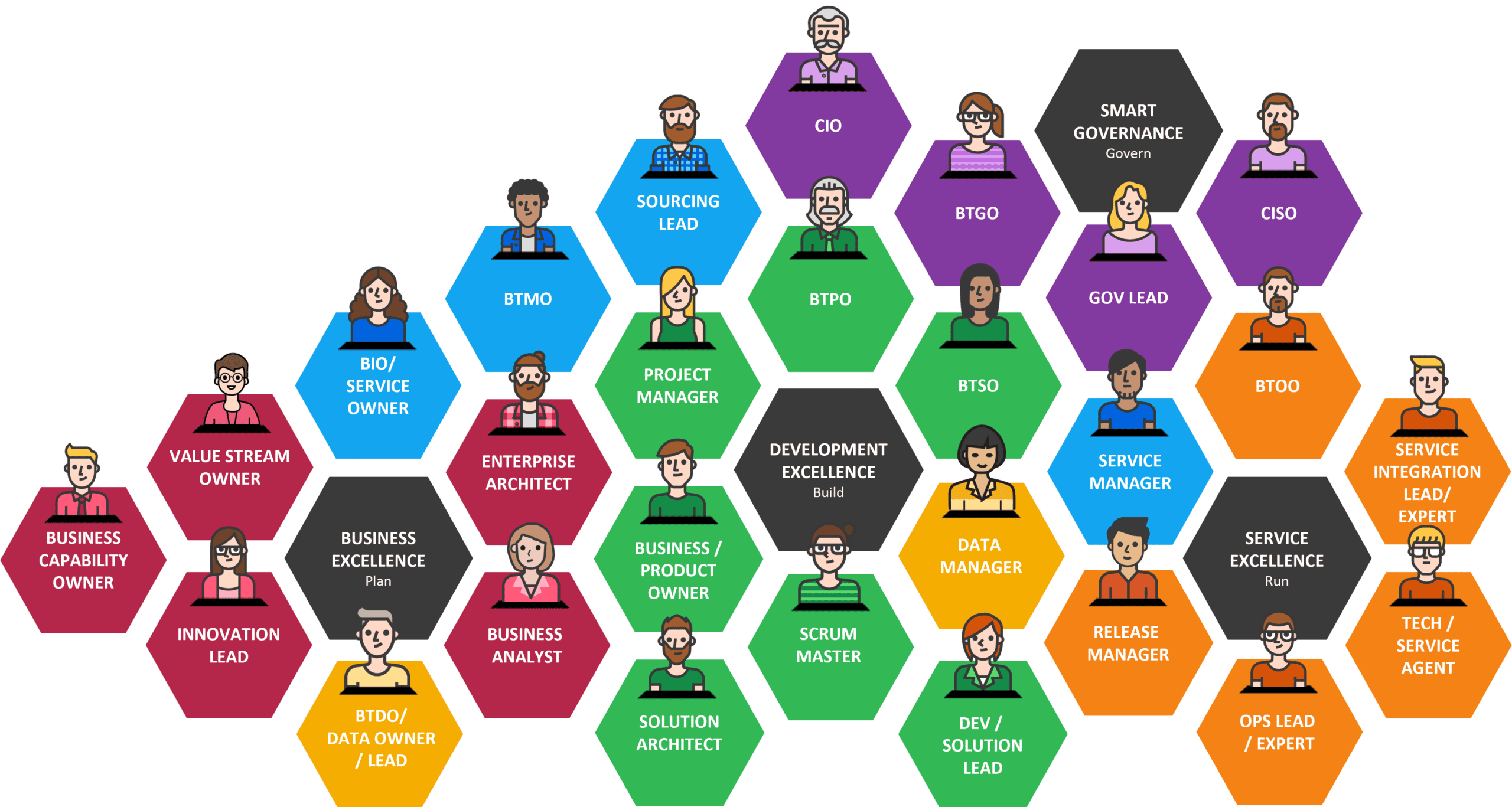
Clear ownership and roles are essential. The Innovation Lead facilitates the idea-to-concept flow, supports experimentation, and maintains visibility of the innovation pipeline. The Business Owner owns the idea and its value potential and is responsible for deciding whether it should be advanced towards a development initiative. Business Analysts support this work by shaping business needs, clarifying assumptions, and translating ideas into structured concepts. Enterprise Architects contribute when a concept requires architectural validation, scalability assessment, or alignment with enterprise principles.
The innovation and concepts process progresses through two main stages. The ideation stage focuses on generating and capturing ideas based on people, processes, data, services, customer needs, and ecosystem insights. Ideas are assessed quickly to determine whether they warrant further exploration.
The concept design stage transforms selected ideas into concrete concepts through rapid validation, prototyping, simulation, experimentation, and testing. This stage clarifies the problem to be solved, the expected business impact, and the feasibility from business, technology, data, and ecosystem perspectives.
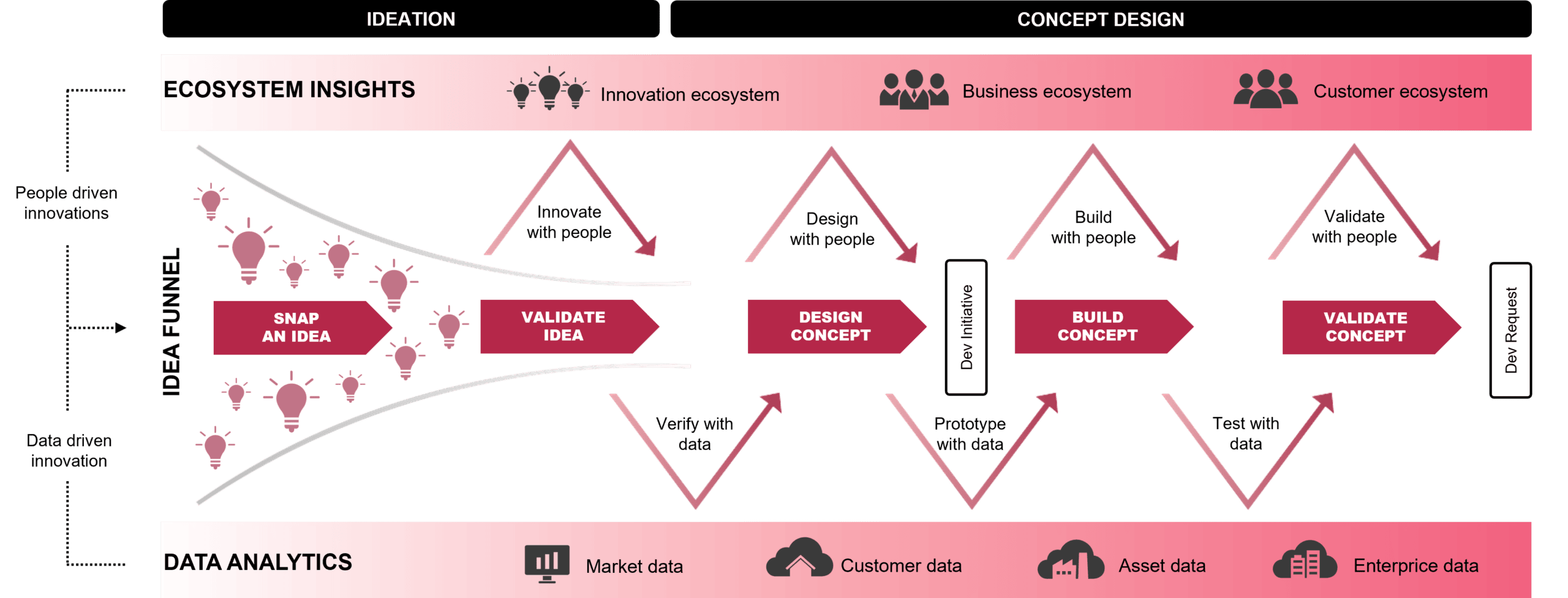
Data and analytics play a central role throughout the process. Evidence from customer data, operational metrics, market signals, user feedback, and experiments is used to validate assumptions and reduce uncertainty. AI can accelerate this work by supporting data analysis, simulation, prototyping, scenario modelling, and concept refinement, but decisions remain grounded in business relevance and accountability rather than technology potential alone.
Financial and governance controls are deliberately lightweight but explicit. Small-scale experimentation is encouraged, while ideas that fail to demonstrate potential are stopped early. Concepts that show promise are escalated into the demand portfolio with increasing clarity on value, risk, ownership, feasibility, and dependencies. Metrics focus on learning speed, conversion of ideas into viable concepts, and realised business value over time.
Intellectual property and data rights are addressed early, especially when partners, external platforms, data, or AI-enabled capabilities are involved. Clear agreements ensure that ownership, usage rights, and responsibilities are understood before concepts transition into development.
AI-assisted concept work can produce prototypes, datasets, generated content, design artefacts, and reusable components whose ownership and allowed use must be understood before the concept is scaled. Through this approach, innovations and concepts provide a disciplined way to explore uncertainty, reduce risk, and ensure that creativity translates into actionable, value-driven business technology initiatives.